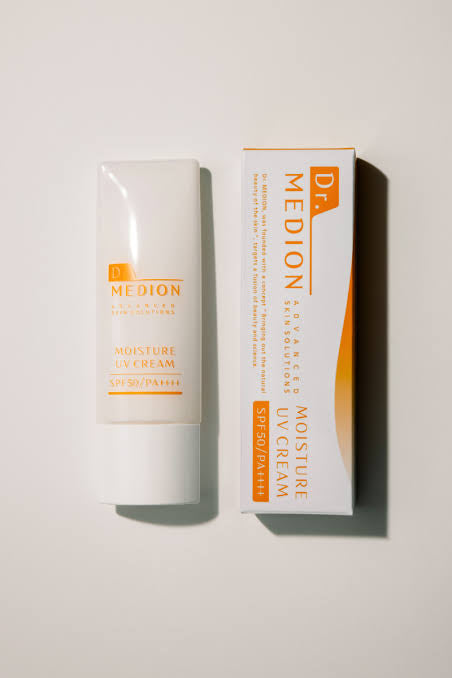
Dr. Medion Moisture UV Cream SPF50+/PA++++
Couldn't load pickup availability
High-Protection Hydrating Sunscreen for Sensitive, Dehydrated or Ageing Skin
Serious sun protection that behaves more like skincare.
Dr. Medion Moisture UV Cream is a lightweight, moisturising daily sunscreen combining SPF50 / PA++++ protection with ceramides, three forms of Hyaluronic Acid, Tremella mushroom polysaccharide and Acetyl Hydroxyproline.
It is designed for people who want strong UVA and UVB protection without the heaviness, dryness or obvious white residue often associated with high-protection sunscreen. The formula is specifically positioned for sensitive and delicate skin, while its hydrating ingredients make it feel much closer to a comfortable moisturising cream than a traditional sunscreen.
I think of it as:
protect → hydrate → strengthen → prevent → preserve.
SPF50 / PA++++ | 30 g | Made in Japan
WHY I LIKE MOISTURE UV CREAM
Because sunscreen is arguably the most important anti-ageing product in your routine — but only if you actually enjoy wearing it.
There is very little value in owning an excellent SPF that feels so heavy, greasy or uncomfortable that you avoid using it.
Moisture UV Cream approaches sun protection differently.
Alongside its high UV protection, we have three human-type ceramides, three forms of Hyaluronic Acid, Tremella Fuciformis polysaccharide and Acetyl Hydroxyproline.
So while the UV filters are protecting the skin from radiation, the rest of the formula is helping maintain hydration, barrier function and skin comfort.
This is sunscreen behaving like proper skincare.
WHO IS MOISTURE UV CREAM FOR?
I particularly like it for:
Daily sun protection
For anyone who understands that SPF isn't reserved for beach holidays.
Sensitive skin
The formula was specifically developed with delicate and easily irritated skin in mind.
Dehydrated skin
Three forms of Hyaluronic Acid, ceramides and Tremella help maintain moisture while the skin is protected.
Dry skin
Particularly when conventional sunscreens leave your face feeling tight or uncomfortable.
Pigmentation-prone skin
Because consistent UV protection is one of the most important parts of managing unwanted pigmentation.
Ageing and photoaged skin
When prevention of further UV-related collagen damage is a priority.
Anyone using an active skincare routine
Particularly when your routine includes ingredients or treatments that make diligent sun protection especially important.
Under makeup
Its lightweight, smooth finish is designed to sit comfortably as the final skincare step before makeup.
SPF50 + PA++++ — WHAT DO THEY ACTUALLY MEAN?
You will see both ratings on the tube because they tell us slightly different things.
SPF50 primarily tells us about UVB protection.
UVB is strongly associated with:
sunburn
direct DNA damage
and the development of skin cancers.
PA++++ tells us about UVA protection.
UVA penetrates more deeply and plays an important role in:
photoageing
pigmentation
collagen degradation
and loss of elasticity.
PA++++ is the highest category within the PA rating system.
So this isn't simply about preventing your face from burning.
It is about protecting the skin from the UV exposure responsible for a significant amount of the ageing we eventually see in the mirror.
WHY SUNSCREEN IS ONE OF THE BEST ANTI-AGEING PRODUCTS YOU CAN OWN
We spend enormous amounts of time discussing:
peptides.
collagen.
retinoids.
antioxidants.
growth factors.
and increasingly sophisticated anti-ageing technology.
But if we repeatedly expose the skin to UV radiation without adequate protection, we are simultaneously contributing to the processes we are trying to correct.
UVA exposure contributes to the breakdown and alteration of the structures responsible for skin firmness and elasticity.
So if your goals include:
fewer wrinkles
more even pigmentation
better firmness
and healthier-looking skin over time,
daily UV protection isn't the optional final step.
It is part of the treatment.
THREE HUMAN-TYPE CERAMIDES — BARRIER SUPPORT
Moisture UV Cream contains three ceramides listed in the current Japanese formula as:
Ceramide NP
Ceramide NG
Ceramide AP.
Ceramides are lipids naturally found within the skin barrier.
Think of the outer skin rather like a brick wall.
The skin cells are the bricks.
Ceramides form part of the lipid material helping hold everything together.
When that lipid structure is compromised, the skin can lose water more easily and become:
dry
tight
sensitive
and more vulnerable to external irritants.
Including ceramides in a daily sunscreen makes perfect sense.
We are not only protecting against UV.
We are supporting the barrier that protects you from everything else.
TRIPLE HYALURONIC ACID — THREE APPROACHES TO HYDRATION
Dr. Medion uses three forms of Hyaluronic Acid:
Sodium Hyaluronate
Sodium Acetylated Hyaluronate
Hydrolysed Hyaluronic Acid.
They differ in structure and behaviour, allowing the formula to approach hydration in slightly different ways across the skin's outer layers.
The practical result?
Better moisture retention and skin that feels:
softer
smoother
plumper
and more comfortable throughout the day.
This is particularly useful if you've ever experienced the strange phenomenon of applying sunscreen in the morning and feeling like your face has become progressively drier by lunchtime.
TREMELLA FUCIFORMIS — THE SNOW MUSHROOM
This is one of the more interesting ingredients in the formula.
Tremella Fuciformis, commonly known as Snow Mushroom, produces polysaccharides with excellent water-binding and skin-conditioning properties.
Dr. Medion combines Tremella with its three forms of Hyaluronic Acid and ceramides to create a much more complete hydration system.
Rather than relying on one famous moisturising ingredient, we have several mechanisms helping the skin maintain water.
Think:
Hyaluronic Acid + Tremella + Ceramides
as the moisturising backbone of the formula.
ACETYL HYDROXYPROLINE — THE ANTI-AGEING EXTRA
This is where Moisture UV Cream becomes particularly interesting as an anti-ageing sunscreen.
Hydroxyproline is an amino acid closely associated with collagen structure.
Dr. Medion includes the derivative Acetyl Hydroxyproline as part of the formula's strategy for supporting skin affected by UVA exposure and maintaining firmness and resilience.
I would not describe this as something that magically repairs every bit of UV damage already accumulated in the skin.
Its value is more sensible than that:
we are combining high UVA protection with an ingredient selected to support the skin structures we're trying to preserve.
Protection first.
Support second.
WHAT ABOUT THE UV FILTERS?
Moisture UV Cream uses a combination of UV filters to provide broad-spectrum protection.
The formula includes filters such as Octocrylene, Avobenzone and Diethylamino Hydroxybenzoyl Hexyl Benzoate, alongside additional UV-filter technology.
Dr. Medion also uses an encapsulation technology designed to minimise direct contact between certain UV absorbers and the skin, which is part of why the product is positioned for sensitive skin.
The important client takeaway is much simpler:
high protection does not have to mean uncomfortable protection.
WILL IT LEAVE A WHITE CAST?
Dr. Medion specifically developed Moisture UV Cream to avoid the conspicuous white residue associated with some high-SPF sunscreens.
That also makes it easier to use underneath makeup without fighting a chalky base.
And this matters more than it sounds.
The best sunscreen isn't necessarily the one with the most impressive marketing story.
It is the one you are happy to apply properly and consistently.
IS IT GOOD UNDER MAKEUP?
Yes.
This is one of its strengths.
The formula has a lightweight, silky texture and is designed to leave the skin hydrated and ready for makeup rather than greasy or heavily coated.
Apply it after your morning skincare and give it a moment to settle before starting makeup.
And importantly:
don't mix your sunscreen into your foundation.
Apply sunscreen as its own proper layer first.
Your SPF rating was tested as sunscreen, not as a creative cocktail with your favourite skin tint.
IS IT SUITABLE FOR SENSITIVE SKIN?
Yes — sensitive skin is one of the main reasons this formula exists.
Dr. Medion describes Moisture UV Cream as a low-irritation formula developed specifically for sensitive and delicate skin.
It is formulated without alcohol, synthetic fragrance or artificial colourants. It does, however, contain natural orange oil, so I would still recommend individual caution if you know your skin reacts specifically to essential oils.
“Suitable for sensitive skin” never means every sensitive person on Earth is guaranteed to tolerate every ingredient.
Skin remains annoyingly individual.
WHAT ABOUT PIGMENTATION?
If pigmentation is one of your concerns, sunscreen is not optional.
UV exposure can stimulate melanogenesis and contribute to the persistence and recurrence of unwanted pigmentation.
That means you can invest in excellent brightening serums, masks and professional treatments — but if UV protection is inconsistent, you are making their job considerably harder.
Think:
pigmentation treatment without sunscreen = correction without prevention.
And prevention is usually much easier.
HOW TO USE MOISTURE UV CREAM
Apply it as the final step of your morning skincare routine.
Use a generous, even amount over the face and other exposed areas.
Dr. Medion's Japanese directions recommend approximately a 1–2 cm diameter amount for the whole face and advise reapplication to maintain protection, particularly after significant sweating.
Your routine becomes:
Cleanse → serum/treatment → moisturiser if needed → Moisture UV Cream → makeup.
If the sunscreen provides enough moisture for your skin, you may find that you do not need a separate moisturiser underneath.
DO I NEED SUNSCREEN WHEN IT'S CLOUDY?
Yes.
Cloudy does not mean UV-free.
UVA in particular is relevant throughout ordinary daily life, which is why I prefer thinking of sunscreen as part of the morning skincare routine, rather than something you remember only when the weather looks impressive.
If daylight is part of your day, UV protection should at least be part of the conversation.
DO I NEED TO REAPPLY?
Yes, particularly when UV exposure is significant.
Reapplication becomes especially important after:
sweating
swimming
wiping or rubbing the face
or spending prolonged periods outdoors.
Dr. Medion also specifically instructs users to reapply to maintain the sunscreen's protective effect, especially after heavy sweating.
One morning application should not automatically be treated as an invisible force field lasting indefinitely.
MY MOISTURE UV CREAM RULES
SPF is skincare.
Especially if ageing or pigmentation is one of your concerns.
SPF50 primarily tells you about UVB protection.
PA++++ indicates very high UVA protection.
Ceramides support the skin barrier while you protect it.
Three forms of Hyaluronic Acid + Tremella provide serious hydration support.
Acetyl Hydroxyproline adds an interesting collagen-supporting element to the formula.
High SPF doesn't have to feel heavy.
Apply sunscreen as its own layer.
Don't dilute it by mixing it with foundation or moisturiser.
Use enough.
A tiny decorative dot of SPF cannot provide the protection level printed on the tube.
Reapply when necessary.
And most importantly:
the sunscreen you wear consistently will do considerably more for your skin than the “perfect” sunscreen sitting unused in your bathroom.
THE BOTTOM LINE
Dr. Medion Moisture UV Cream is the one I choose when I want serious daily UV protection without sacrificing hydration, comfort or the elegance of the rest of my skincare routine.
SPF50 / PA++++ provides high UVA and UVB protection.
Three human-type ceramides support the skin barrier.
Three forms of Hyaluronic Acid replenish hydration.
Tremella polysaccharide helps maintain moisture.
And Acetyl Hydroxyproline adds an additional skin-supporting dimension to a formula already focused on preventing photoageing.
The result is exactly what I want from a sophisticated daily SPF:
high protection.
comfortable hydration.
no heavy sunscreen feeling.
a smooth base for makeup.
And protection against one of the biggest external contributors to premature skin ageing.
Because we can discuss anti-ageing ingredients all day long.
But if you want to preserve the skin you're investing so much time and money into:
protect it from the sun.
Every day.
DR. MEDION MOISTURE UV CREAM AT A GLANCE
What is it?
A high-protection, moisturising daily facial sunscreen.
Protection:
SPF50 / PA++++.
Best for:
Daily UV protection, sensitive skin, dehydration, dryness, pigmentation prevention and photoageing concerns.
Suitable for:
Normal, dry, dehydrated and sensitive skin.
Does it protect against UVA and UVB?
Yes.
Does it leave a white cast?
It is specifically formulated to avoid the obvious white residue associated with some high-protection sunscreens.
Is it moisturising?
Yes. It combines three ceramides, three forms of Hyaluronic Acid and Tremella polysaccharide.
Can I use it under makeup?
Yes. Apply it as the final skincare step and allow it to settle before makeup.
Do I still need moisturiser?
That depends on your skin. For some people, Moisture UV Cream may provide enough daytime moisture on its own.
Is it suitable for sensitive skin?
Yes. It was specifically developed with sensitive and delicate skin in mind.
Is it alcohol-free?
Dr. Medion states that it is formulated without alcohol.
Is it fragrance-free?
It contains no synthetic fragrance, but the INCI does contain natural orange oil.
Does it contain ceramides?
Yes — Ceramide NP, NG and AP are listed in the current Japanese formula.
Does it contain Hyaluronic Acid?
Yes — three forms.
When do I apply it?
As the final step of your morning skincare, before makeup.
Do I need to reapply?
Yes, particularly during significant sun exposure and after heavy sweating.
Hero ingredients:
Three human-type Ceramides, Triple Hyaluronic Acid, Tremella Fuciformis Polysaccharide and Acetyl Hydroxyproline.
Size:
30 g.
Made in:
Japan.
Best simple routine:
Cleanse → treatment/serum → moisturiser if needed → Moisture UV Cream SPF50 / PA++++ → makeup