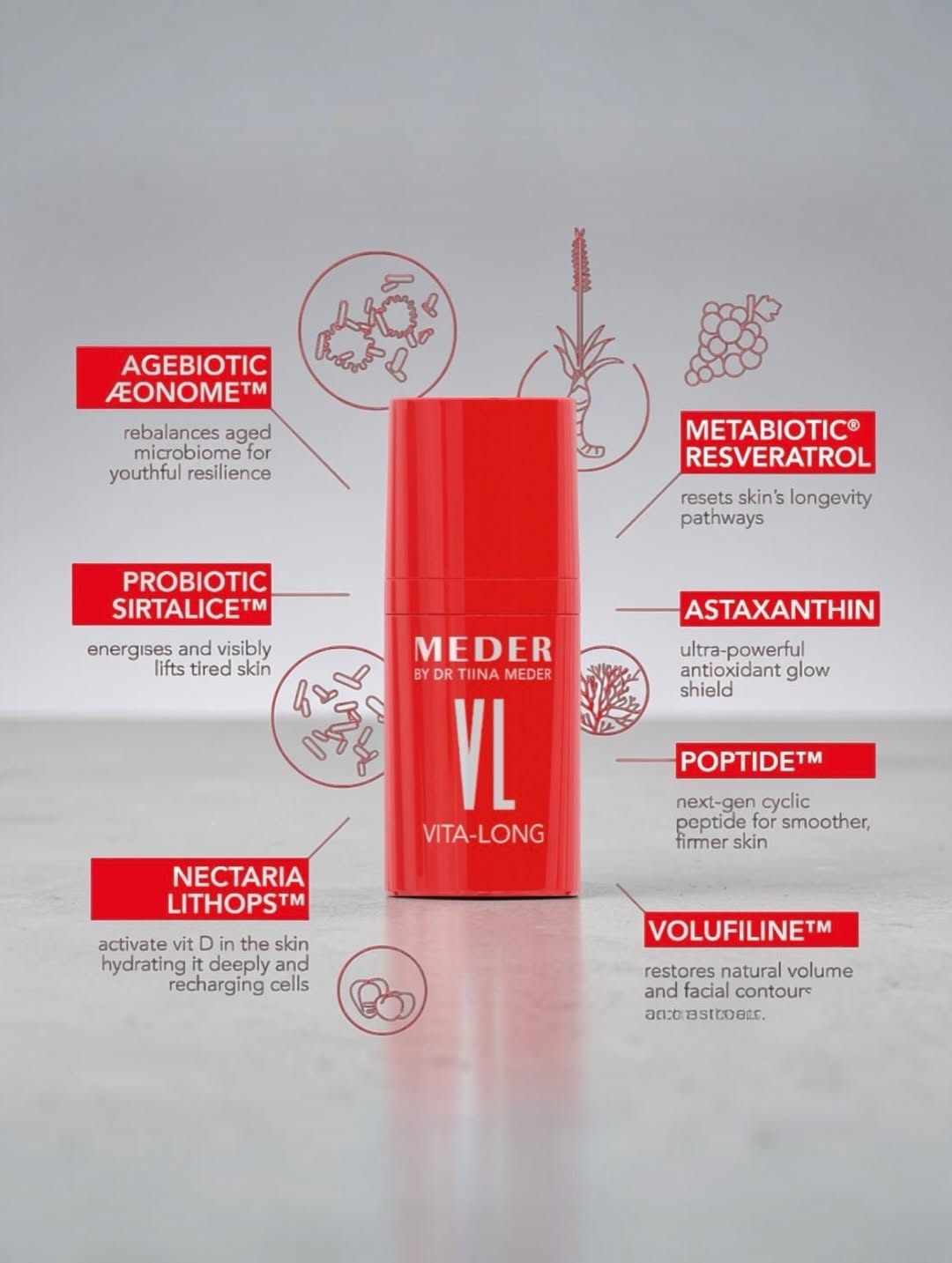
Meder Vita-Long 2.0 Advanced Skin Longevity Active Care
Instead of waiting for your skin to age and then trying to correct it, what if we helped it stay healthier for longer?
Vita-Long 2.0 is one of the most interesting products in the MEDER range because it approaches ageing from a completely different direction.
Most traditional anti-ageing skincare starts with what we can already see.
A wrinkle appears.
Skin loses firmness.
The complexion becomes dull.
Texture changes.
And then we look for an ingredient to correct that particular problem.
Vita-Long 2.0 asks a different question:
What is happening inside ageing skin before all of those changes become visible?
Because wrinkles, loss of elasticity, dullness and slower recovery aren't isolated events.
They're outward signs of much deeper biological changes happening gradually within the skin.
So rather than simply chasing individual wrinkles, Vita-Long 2.0 is designed around the concept of skin longevity.
I think of it as:
protect → energise → repair → strengthen → preserve.
The goal isn't to stop ageing.
It's to help your skin stay healthy, resilient and biologically active for as long as possible.
WHY I LIKE VITA-LONG 2.0
There is a big difference between looking temporarily younger and helping skin age better.
You can plump a dehydration line.
You can exfoliate dull surface cells.
You can temporarily make skin look smoother.
All of those things have value.
But longevity skincare looks further ahead.
We're asking:
How well are your skin cells functioning?
How efficiently are they producing energy?
How well can they respond to environmental stress?
How healthy is the skin barrier?
How balanced is the microbiome?
How efficiently can the skin renew and repair itself?
How much chronic low-level inflammation is present?
And how well are the structural proteins supporting firmness and elasticity being maintained?
Vita-Long 2.0 was developed around those bigger questions.
That's why I don't really think of it as simply another "anti-wrinkle serum."
It's more like a long-term investment in how your skin ages.
WHO IS VITA-LONG 2.0 FOR?
I particularly like Vita-Long 2.0 for skin that is:
Beginning to show the first visible signs of ageing
When fine lines, subtle loss of firmness or changes in texture are starting to appear.
35+ and thinking preventatively
When we're no longer only correcting problems but actively trying to preserve healthy skin function.
Dull or tired-looking
When the complexion has lost some of its previous freshness and vitality.
Losing elasticity and resilience
When skin doesn't feel quite as firm, springy or strong as it once did.
Dehydrated or barrier-weakened
When the skin struggles to hold onto moisture or becomes more vulnerable to environmental stress.
Uneven in tone or texture
When ageing is beginning to show as general deterioration in skin quality rather than one specific concern.
Environmentally stressed
When UV exposure, pollution, temperature changes and everyday oxidative stress are contributing to premature ageing.
Recovering more slowly than it used to
When the skin seems to take longer to bounce back after stress or professional treatments.
Already showing wrinkles and loss of firmness
Because longevity skincare isn't only preventative — it can also support skin in which age-related changes are already visible.
This is one of those products I particularly like for somebody who tells me:
"Nothing is terribly wrong with my skin. I just want to keep it good."
That is exactly where longevity skincare makes sense.
WHY DOES MEDER RECOMMEND IT FROM 35+?
MEDER currently recommends Vita-Long 2.0 from approximately 35 years onwards.
Again, nothing dramatic happens to your face on your 35th birthday.
The idea is that this is around the stage when many of the biological processes associated with ageing are gradually becoming more relevant, even if the visible changes are still relatively subtle.
This makes Vita-Long different from Arma-Lift.
With Arma-Lift, we're generally responding to more established age-related and hormone-related changes, particularly from around 40+ and into menopause.
Vita-Long can enter the picture earlier.
It's much more about:
preserving function before significant decline becomes established.
So if you're 35–40 and wondering:
"Do I really need an aggressive anti-ageing programme already?"
My answer is often:
Probably not.
But supporting the skin's longevity, antioxidant defence, barrier and resilience?
That makes much more sense.
WHAT DOES “SKIN LONGEVITY” ACTUALLY MEAN?
This phrase is becoming very fashionable, so I want to make sure it actually means something.
Skin longevity isn't about making you immortal.
And it isn't about trying to make a 55-year-old face look 25.
It's about helping the skin maintain healthy function for longer.
Think about the difference between lifespan and healthspan.
Living longer is one thing.
Living longer while remaining healthy, strong and functional is another.
Longevity science increasingly focuses on that second idea.
We can apply a similar philosophy to skin.
Instead of asking only:
"How do I erase this wrinkle?"
we ask:
"How do I help this skin remain resilient, functional and capable of repairing itself as it gets older?"
The visible result should follow the biology.
Healthier-functioning skin generally looks:
brighter
smoother
firmer
better hydrated
more even
more resilient
and ultimately younger for its age.
That's what longevity means to me in skincare.
THE “HALLMARKS OF AGEING” — WHAT DOES THAT ACTUALLY MEAN?
This is the science behind Vita-Long 2.0.
Researchers studying biological ageing identified a group of interconnected processes that tend to become disrupted as organisms age.
These became known as the hallmarks of ageing.
MEDER says Vita-Long 2.0 was formulated to address 11 of the 12 currently recognised hallmarks.
That sounds impressive — but unless you're studying molecular biology, it probably doesn't mean very much on its own.
So let's make it practical.
As skin ages:
DNA accumulates damage.
Cells become less efficient at producing energy.
Some damaged or aged cells stop functioning normally.
Cellular communication changes.
Inflammation can become more persistent.
The microbiome can change.
Repair and regeneration become less efficient.
Structural proteins become less organised.
And the skin becomes less capable of responding to stress.
These processes don't happen independently.
They influence one another.
And eventually we see the result in the mirror as:
wrinkles
loss of firmness
dullness
uneven texture
dehydration
slower recovery
reduced resilience.
Vita-Long 2.0 is MEDER's attempt to work on many of these underlying processes simultaneously rather than targeting one visible symptom at a time.
WHAT DOES VITA-LONG 2.0 ACTUALLY DO?
Think of Vita-Long 2.0 as helping ageing skin maintain its operating system.
We're supporting several things at once.
Cellular energy
Because skin cells need energy to perform their normal functions efficiently.
Antioxidant protection
Helping defend the skin against oxidative stress from UV exposure, pollution and everyday environmental damage.
Skin renewal and resilience
Supporting the skin's ability to recover and remain active.
Barrier function
Helping skin retain moisture and defend itself more effectively.
Microbiome balance
Because healthy skin doesn't exist independently of the microorganisms living on it.
Structural support
Helping maintain the proteins and processes involved in firmness, elasticity and density.
Inflammaging control
Supporting the skin against chronic low-level inflammatory stress associated with ageing.
So Vita-Long isn't trying to produce one dramatic effect.
It's trying to help the skin function better as a whole.
WHAT IS CELLULAR FATIGUE?
This is another phrase you'll see around longevity skincare.
Your skin cells need energy.
A huge amount of that energy is generated by structures inside cells called mitochondria.
You can think of mitochondria as tiny cellular power stations.
As we age — and as cells accumulate damage and stress — energy production can become less efficient.
And a cell that doesn't have enough energy can't perform all of its jobs optimally.
Repair.
Renewal.
Protein production.
Defence.
Communication.
All of these processes require energy.
So when MEDER talks about re-energising ageing skin, we're not talking about giving your face the cosmetic equivalent of an espresso.
We're talking about supporting the cellular processes involved in energy and normal function.
That's much more meaningful.
WHAT IS CELLULAR SENESCENCE?
This sounds complicated, but the idea is actually fascinating.
Most healthy cells don't divide forever.
Eventually, some cells reach a stage where they stop dividing.
These are known as senescent cells.
The problem isn't simply that they've stopped reproducing.
Some senescent cells can also release inflammatory signals into the surrounding tissue.
You may hear them rather dramatically called "zombie cells."
I don't particularly love that term, but it does make the concept easy to remember:
The cell isn't functioning normally anymore, but it hasn't disappeared either.
As senescent cells accumulate with age, they can contribute to the inflammatory and structural environment associated with ageing.
Longevity skincare is increasingly interested in how we can support healthier cellular behaviour rather than focusing only on what the surface of the skin looks like.
WHAT IS INFLAMMAGING?
We've discussed this with Arma-Lift, but it's particularly relevant to Vita-Long.
Inflammaging describes the persistent low-level inflammatory activity associated with ageing.
Not the obvious inflammation of a rash.
Not a swollen injury.
Something much quieter.
Over time, chronic low-grade inflammatory signalling can influence collagen, barrier function, cellular communication and the way tissues age.
UV exposure, pollution, oxidative stress and lifestyle factors can all contribute.
So one of the goals of longevity skincare is not simply to stimulate the skin harder.
It's also to help create a healthier, less stressful environment in which the skin can function.
Sometimes supporting the skin is more intelligent than constantly pushing it.
HOW TO USE VITA-LONG 2.0
Vita-Long 2.0 is an Active Care emulsion, so it comes after your everyday antioxidant serum and before moisturiser.
For non-sensitive skin, a typical routine may look like:
Energy-Net → Energy-Soin → Vita-Long 2.0 → Moisturiser
For sensitive skin:
Net-Apax → Soin-Apax → Vita-Long 2.0 → Moisturiser
STEP 1 — CLEANSE
Start with the MEDER cleanser appropriate for your skin.
Energy-Net for non-sensitive skin.
Net-Apax when sensitivity or redness is a concern.
STEP 2 — APPLY YOUR EVERYDAY SERUM
Apply Energy-Soin or Soin-Apax and allow it to absorb.
This gives us our everyday antioxidant foundation.
STEP 3 — APPLY VITA-LONG 2.0
Apply approximately one pump to the face and neck.
Gently press and smooth it into the skin.
The new 2.0 formula is a lightweight silky emulsion rather than the facial oil texture of the original Vita-Long.
STEP 4 — ALLOW IT TO ABSORB
Give it a moment to settle.
There's no need to massage aggressively.
STEP 5 — MOISTURISE
Follow with the MEDER moisturiser selected for your skin.
During the day, finish with appropriate sun protection.
HOW OFTEN SHOULD I USE IT?
Vita-Long 2.0 is designed to be used morning and evening.
But the recommended programme changes slightly according to age.
AGES 35–45
Use Vita-Long 2.0 for approximately 7–8 weeks, once or twice per year.
Think of it as a targeted longevity programme rather than necessarily something you need permanently.
AGES 45–55
Use it for approximately 8 weeks, followed by a break of around 4–8 weeks, then repeat as appropriate.
AGE 55+
MEDER states that Vita-Long 2.0 can be used continuously as part of your everyday skincare routine.
I actually like this age-based approach.
It recognises that skin at 37 doesn't necessarily need exactly the same intensity of longevity support as skin at 67.
YOUR MORNING ROUTINE
1. Energy-Net / Net-Apax
Choose according to sensitivity.
2. Energy-Soin / Soin-Apax
Your everyday antioxidant serum.
3. Vita-Long 2.0
Your targeted skin-longevity step.
4. Your MEDER Moisturiser
5. SPF
YOUR EVENING ROUTINE
If you're wearing substantial makeup:
1. Remove your makeup
2. Energy-Net / Net-Apax
3. Energy-Soin / Soin-Apax
4. Vita-Long 2.0
5. Your MEDER Moisturiser
One of the things I like about Vita-Long is that it doesn't require an elaborate routine around it.
The sophistication is inside the formula.
Your routine can remain beautifully simple.
WHAT'S INSIDE IT?
This is where Vita-Long 2.0 becomes particularly interesting.
MEDER highlights seven active technologies working across different aspects of skin ageing.
METABIOTIC® RESVERATROL
Resveratrol is a powerful antioxidant compound associated with plants such as grapes.
Vita-Long uses a fermented / metabiotic form of resveratrol.
Its role is particularly relevant to oxidative stress, inflammatory processes and the cellular environment associated with ageing.
In simple terms:
every day your skin is exposed to stress.
UV.
Pollution.
Temperature changes.
Normal metabolism.
And all of these contribute to oxidative damage over time.
Resveratrol helps us strengthen the skin's antioxidant defence system against that accumulated stress.
ASTAXANTHIN
Astaxanthin is a naturally occurring carotenoid pigment produced by microalgae.
It's responsible for some of the red-orange colour we see elsewhere in nature.
But in skincare, we're interested in it because it's a potent antioxidant.
Oxidative stress is one of the major contributors to premature skin ageing.
So astaxanthin gives Vita-Long another layer of antioxidant protection, complementing resveratrol rather than relying on a single antioxidant to do everything.
Think:
better defence against accumulated environmental stress.
SIRTALICE™
Sirtalice™ is a biotechnology-derived active associated with cellular energy and skin firmness.
This is where the mitochondrial side of longevity becomes particularly interesting.
Remember:
if a skin cell doesn't have enough energy, it cannot perform its normal functions as efficiently.
Sirtalice™ is included to support cellular energy processes and help ageing skin maintain better functional activity.
For you, the practical result we're looking for is:
skin that looks less tired, more resilient and better supported.
POPTIDE™ PEPTIDE
Poptide™ is a peptide technology used to support the organisation and quality of the skin's structural proteins.
And this matters because ageing isn't simply about producing "more collagen."
The way structural proteins are organised matters too.
Healthy skin architecture depends on a complex network of proteins working together.
So rather than thinking:
peptide = magically makes collagen
I want you thinking:
peptide = sends signals that help support healthier skin structure and organisation.
That's a much more useful explanation.
AGEBIOTIC AENOME™
Agebiotic Aenome™ brings the microbiome into the longevity story.
We've already talked extensively about the microbiome in Eu-Seb and Red-Apax.
But microbiome balance isn't only relevant to acne and redness.
It also changes with age.
The microorganisms living on our skin interact with barrier function, inflammation and immune signalling.
So if we're genuinely thinking about skin longevity, we can't ignore the ecosystem living on the surface.
Agebiotic Aenome™ is designed to support a younger, healthier microbiome profile and help reinforce skin resilience.
Again, we're treating the skin as an ecosystem — not as an isolated sheet of cells.
NECTARIA LITHOPS™
Nectaria Lithops™ is derived from Lithops, sometimes known as a "living stone" plant.
These remarkable plants survive extremely dry conditions by managing water very efficiently.
Within skincare, the Lithops-derived active is used to support hydration, barrier function and cellular vitality.
And I love the logic here.
Ageing skin often becomes worse at retaining water and recovering from environmental stress.
So we're not only thinking about wrinkles.
We're helping the skin remain hydrated, functional and resilient.
VOLUFILINE™
Volufiline™ is derived from Anemarrhena asphodeloides root extract.
Its role within Vita-Long is associated with improving the appearance of skin density and plumpness.
This becomes particularly relevant as ageing skin gradually loses some of its previous fullness and structural quality.
Again, I want realistic expectations.
We're not talking about a topical injectable filler.
We're talking about supporting a plumper, denser-looking skin appearance over time.
That distinction matters.
AND WHAT ABOUT THE KIMCHI PROBIOTIC?
Vita-Long 2.0 also contains Leuconostoc/Radish Root Ferment Filtrate, a fermentation-derived ingredient associated with MEDER's microbiome-friendly approach.
You'll sometimes see this described in the longevity story as a kimchi-derived probiotic technology.
The important point isn't that we're putting Korean fermented vegetables on your face.
We're using biotechnology inspired by fermentation and beneficial microorganisms to help support the skin's ecosystem and formula performance.
This fits beautifully with the overall MEDER philosophy:
Healthy ageing isn't only about human skin cells.
It's also about maintaining the environment those cells live in.
DOES VITA-LONG 2.0 CONTAIN RETINOL?
No.
Vita-Long 2.0 does not contain traditional retinol.
And MEDER doesn't recommend routinely combining it with retinol because Vita-Long already targets many of the concerns for which people normally introduce retinoids.
Wrinkles.
Texture.
Firmness.
Renewal.
Skin resilience.
The brand states that combining the two isn't inherently harmful, but generally considers it unnecessary.
And I agree with the principle behind that.
The question shouldn't be:
"How many anti-ageing actives can I fit into one routine?"
It should be:
"What does my skin actually need?"
More isn't automatically better.
IS VITA-LONG 2.0 PHOTOSENSITISING?
No.
MEDER states that Vita-Long 2.0 doesn't increase the skin's sensitivity to sunlight.
That means it can be used throughout the year, including during summer.
In fact, its antioxidant and resilience-supporting ingredients make environmental protection an important part of its purpose.
But please don't translate:
"not photosensitising"
into:
"I don't need sunscreen."
You absolutely do.
UV exposure remains one of the most important external contributors to premature skin ageing.
If we're investing in longevity skincare while repeatedly allowing unnecessary UV damage, we're working against ourselves.
VITA-LONG 2.0 AND SUN DAMAGE
This is where Vita-Long makes a lot of sense.
UV exposure creates oxidative stress and cellular damage.
Some of that damage is immediately visible as redness or tanning.
Much of it isn't.
It accumulates quietly over years.
Eventually we see the consequences as:
pigmentation.
wrinkles.
loss of elasticity.
uneven texture.
and changes in skin quality.
Vita-Long's job isn't to replace sunscreen or somehow undo every hour you've ever spent in the sun.
Its role is to help support the skin's antioxidant defence, resilience and recovery from environmental stress.
Think of SPF and Vita-Long as doing different jobs.
SPF helps reduce incoming UV damage.
Vita-Long helps support the skin dealing with the biological consequences of everyday stress.
I want both.
VITA-LONG 2.0 VS THE ORIGINAL VITA-LONG OIL
If you've used MEDER for a long time, you may remember Vita-Long as an oil.
Vita-Long 2.0 is a substantial reformulation.
The original Vita-Long was created around an earlier understanding of the hallmarks of ageing and targeted a smaller number of those biological pathways.
The 2.0 version was developed as a much broader longevity formula, which MEDER now says addresses 11 of the 12 recognised hallmarks of ageing.
The texture has changed too.
ORIGINAL VITA-LONG
An oil-based longevity treatment.
VITA-LONG 2.0
A silky lightweight emulsion with a much broader combination of biotechnology-derived longevity actives.
So if you previously avoided Vita-Long because you don't enjoy facial oils, don't assume the new version feels the same.
It doesn't.
VITA-LONG 2.0 OR ARMA-LIFT?
This is an important comparison because both belong in the age-well conversation.
But they aren't identical.
CHOOSE VITA-LONG 2.0 IF...
Your focus is skin longevity and prevention.
You want to support cellular function, resilience, antioxidant defence, barrier health, microbiome balance and healthy ageing before advanced age-related changes become dominant.
Think:
How can I help my skin stay healthier for longer?
CHOOSE ARMA-LIFT IF...
We're dealing with more established mature and hormone-related skin changes.
Loss of firmness.
Wrinkles.
Fragility.
Menopausal changes.
Declining elasticity.
Think:
How do I support skin that is already changing significantly with age?
The simplest distinction is:
Vita-Long = longevity and preservation.
Arma-Lift = targeted correction and support for mature skin.
And depending on your age and skin, these categories can overlap.
WHAT ABOUT VITA-LONG 2.0 AND CIRCA-NIGHT?
These two make a particularly interesting longevity pairing.
Vita-Long 2.0 is your targeted day-and-night longevity active care.
Circa-Night is MEDER's night cream designed around the relationship between skin repair and the body's circadian rhythm.
So Vita-Long supports the broader biological mechanisms involved in healthy ageing, while Circa-Night gives us dedicated overnight support.
A beautiful evening longevity routine can therefore look like:
Cleanse → Antioxidant Serum → Vita-Long 2.0 → Circa-Night
We'll go much deeper into circadian biology when we reach Circa-Night.
WHEN WILL I SEE A DIFFERENCE?
Some of the first changes you may notice are:
better hydration
more radiance
smoother texture
a fresher-looking complexion
These may begin appearing within the first few weeks.
But Vita-Long isn't designed as an instant-event product.
For visible improvements in plumpness, lines, wrinkles and overall skin quality, MEDER recommends consistent use for at least 7–8 weeks.
And with longevity skincare, I don't want you judging success only by whether one wrinkle became two millimetres shorter.
Also ask:
Does my skin look healthier?
Does it recover better?
Does it stay hydrated more easily?
Does it feel stronger?
Does the complexion look brighter?
Does my skin seem less tired and stressed?
Is the texture improving?
Those are extremely valuable results.
CAN VITA-LONG 2.0 REVERSE AGEING?
No.
And I don't think we need to make that claim for this product to be exciting.
We cannot stop chronological ageing.
We cannot make your skin biologically immortal.
And skincare cannot completely erase genetics, hormones, UV history, lifestyle and time.
What we can do is influence some of the processes that determine how well the skin ages.
That's the value of longevity skincare.
The goal isn't:
never age.
It's:
age with healthier, stronger, better-functioning skin.
That's a much more realistic — and much more interesting — objective.
DO I NEED VITA-LONG 2.0 IF I DON'T HAVE WRINKLES YET?
Potentially, yes.
And this is actually one of the situations where Vita-Long makes the most sense.
If you're 35+ and your skin still looks very good, you don't necessarily need to wait until it deteriorates before you start thinking about longevity.
This isn't the same as telling a 20-year-old that they need an aggressive anti-ageing programme.
They don't.
But from the mid-thirties onwards, supporting antioxidant defence, cellular energy, barrier health and resilience can be a very sensible preventative strategy.
I would much rather help you preserve healthy skin than wait until every possible sign of ageing has appeared and then try to reverse it.
CAN I USE VITA-LONG 2.0 AFTER PROFESSIONAL TREATMENTS?
Potentially, yes.
MEDER positions Vita-Long 2.0 as a useful longevity homecare product alongside professional programmes including lasers, energy-based devices, injectables and non-invasive facial treatments.
But please remember:
professional-treatment aftercare always comes first.
Different procedures disrupt the skin to very different degrees.
So don't automatically apply active skincare immediately after a laser, peel or energy treatment because the product contains "repairing" ingredients.
We reintroduce your active homecare when it is appropriate for the treatment you've had.
Once the skin is ready, Vita-Long can become an excellent part of maintaining and supporting the results of professional work.
WHAT SHOULD I USE AFTER VITA-LONG 2.0?
This depends on your skin.
That's actually one of the strengths of Vita-Long.
It isn't tied to one single moisturiser.
For example:
Dry or mature skin
We may choose Arma-Derm.
Normal skin needing hydration and support
Derma-Fill may be appropriate.
Oily skin
Equa-Derm may make more sense.
Night-time longevity support
Circa-Night is an excellent pairing.
Pigmentation and brightness concerns
Lumino-Derm can be particularly interesting during the day.
So the sequence remains:
Cleanser → Everyday Antioxidant Serum → Vita-Long 2.0 → Appropriate Moisturiser → SPF in the morning
The longevity step stays consistent.
The products around it change according to your skin.
MY VITA-LONG 2.0 RULES
If you remember nothing else from this page, remember these:
Longevity isn't the same as anti-wrinkle skincare.
We're trying to preserve healthy skin function, not simply chase individual lines.
Start for the right reason.
MEDER recommends Vita-Long 2.0 from approximately 35+, when longevity support becomes increasingly relevant.
Use it consistently.
Morning and evening gives us the intended programme.
Give it at least 7–8 weeks.
Some improvements may appear sooner, but meaningful longevity care isn't an overnight project.
You don't automatically need retinol as well.
MEDER considers the combination generally unnecessary because Vita-Long already targets many overlapping ageing concerns.
It isn't photosensitising.
But that absolutely doesn't make SPF optional.
Don't expect one dramatic “lifting” moment.
Look for gradual improvement across hydration, radiance, texture, resilience, firmness and overall skin quality.
Think long term.
The whole point of Vita-Long is not only how your skin looks next Friday — it's how well you're supporting the skin you'll have years from now.
THE BOTTOM LINE
Vita-Long 2.0 is the product I want you to think of when the question changes from “How do I fix this wrinkle?” to “How do I help my skin age as well as possible?”
That's what makes it different.
We're not focusing on one line.
One pore.
One patch of pigmentation.
Or one sign of ageing.
We're looking at the biology underneath all of them.
Cellular energy.
Oxidative stress.
Inflammation.
Barrier function.
Microbiome balance.
Structural integrity.
Hydration.
Resilience.
And the skin's ability to keep functioning well as time passes.
The goal isn't to freeze your face at 35.
It's to help your skin remain healthy, active, resilient and beautifully functioning for as long as possible.
Because to me, that's what good longevity skincare should be.
Not fear of getting older.
Better skin for the age you're becoming.
VITA-LONG 2.0 AT A GLANCE
What is it?
An advanced skin-longevity Active Care emulsion designed to support the biological processes involved in healthy skin ageing.
Best for:
Prevention of premature ageing, fine lines, declining firmness and elasticity, dullness, uneven texture, dehydration, weakened barrier function, environmental stress and reduced skin resilience.
Recommended age:
35+
How often?
Morning and evening.
How much?
Approximately one pump for the face and neck.
How long?
35–45: approximately 7–8 weeks, once or twice yearly.
45–55: approximately 8 weeks followed by a 4–8 week break before repeating.
55+: MEDER states it can be used continuously.
Where does it go in my routine?
After Energy-Soin or Soin-Apax and before your moisturiser.
Is Vita-Long 2.0 an oil?
No. Unlike the original Vita-Long Oil, 2.0 is a lightweight silky emulsion.
Does it contain retinol?
No.
Can I combine it with retinol?
MEDER says the combination isn't considered harmful but generally doesn't recommend it because the overlap in intended benefits makes it unnecessary for most people.
Is it photosensitising?
No. It can be used throughout the year, but daily sun protection remains important.
What does “11 of the 12 hallmarks of ageing” mean?
MEDER designed the formula around multiple biological processes associated with ageing rather than targeting only visible wrinkles.
Hero ingredients:
Metabiotic® Resveratrol, Astaxanthin, Sirtalice™, Poptide™ Peptide, Agebiotic Aenome™, Nectaria Lithops™, Volufiline™ and fermentation-derived microbiome support.
What comes next?
Whichever MEDER moisturiser best suits your skin, plus SPF during the day.
Size:
30 ml