Skip to product information
1 of 5

Meder Lumino-Derm Skin Brightening Cream for Pigmentation & Uneven Skin Tone

Meder Lumino-Derm Skin Brightening Cream for Pigmentation & Uneven Skin Tone

Order by request

igmentation isn't simply a dark spot sitting on the surface — and treating it shouldn't mean attacking your skin until the spot disappears.

Lumino-Derm is the MEDER cream I reach for when the main concern is pigmentation, dark spots, melasma, post-inflammatory marks, sun damage or an uneven skin tone.

But what makes this cream particularly interesting is how it approaches pigmentation.

Because pigmentation isn't always simply a case of:

too much melanin = remove melanin.

Pigment production is influenced by UV exposure.

Hormones.

Inflammation.

Skin injury.

Oxidative stress.

And even the biological environment surrounding the pigment-producing cells.

So rather than aggressively exfoliating the skin or trying to bleach away colour, Lumino-Derm is designed to help normalise excessive pigment production while calming and supporting the skin around it.

I think of it as:

calm → regulate → brighten → protect → even.

The goal isn't lighter skin.

It's your natural skin tone — only clearer, more even and more luminous.


WHY I LIKE LUMINO-DERM

Pigmentation treatment has traditionally had a reputation for being quite aggressive.

Strong acids.

Retinoids.

Hydroquinone.

Peeling.

Irritation.

Sun sensitivity.

And sometimes the unfortunate cycle of:

treat pigmentation → irritate skin → create inflammation → trigger more pigmentation.

That's particularly problematic if your skin is prone to post-inflammatory hyperpigmentation or melasma.

Because inflammation itself can become part of the pigmentation problem.

Lumino-Derm takes a much calmer approach.

We're still actively targeting unwanted pigment.

But at the same time, we're supporting:

inflammation control

antioxidant protection

microbiome balance

skin barrier comfort

and the skin's resilience against environmental stress.

That's a philosophy I really like.

Effective pigmentation treatment shouldn't require us to destroy healthy skin in the process.


WHO IS LUMINO-DERM FOR?

I particularly like Lumino-Derm for:

Dark spots
Individual areas of excess pigmentation that have become more visible over time.

Sun spots
Pigmentation associated with accumulated UV exposure.

Melasma
Patchy pigmentation influenced by hormones, UV exposure and other biological triggers.

Post-inflammatory hyperpigmentation — PIH
Dark marks left behind after acne, inflammation, irritation or skin injury.

Uneven skin tone
When the complexion generally looks patchy rather than uniformly clear.

Post-acne marks
Particularly brown or greyish marks remaining after the active blemish has healed.

Hormonal pigmentation
Including pigmentation associated with pregnancy and other hormonal changes.

Premature sun damage
When years of UV exposure are beginning to show as uneven pigmentation.

Sensitive skin with pigmentation
When aggressive brightening programmes are likely to create too much irritation.

Anyone wanting brighter, more luminous skin
Even when there isn't one dramatic dark spot, but the complexion has become dull and uneven.

And importantly, Lumino-Derm is designed for all skin tones.

We're not trying to change your natural colour.

We're targeting the unwanted excess pigment that makes the skin look uneven.


WHAT ACTUALLY CAUSES PIGMENTATION?

To understand Lumino-Derm, we need to understand melanin.

Melanin is the pigment responsible for much of the colour in our skin, hair and eyes.

And melanin is not the enemy.

It has an important protective function.

Your skin produces melanin partly in response to UV exposure, helping protect cells against radiation.

Specialised cells called melanocytes produce melanin and distribute pigment to surrounding skin cells.

Normally, this process contributes to your natural skin colour.

The problem begins when pigment production becomes excessive or uneven.

Then instead of an even skin tone, we may see:

spots.

patches.

post-acne marks.

melasma.

or general unevenness.

So the goal of good pigmentation skincare isn't:

stop making melanin.

It's:

help restore healthier, more controlled pigment production.


WHY DOES PIGMENTATION KEEP COMING BACK?

This is probably one of the most important things to understand.

A dark spot isn't always an isolated cosmetic defect.

Often, there is a trigger behind it.

UV exposure.

Hormonal changes.

Inflammation.

Acne.

Skin injury.

Heat.

Certain medications.

Or repeated irritation.

If we only remove visible surface pigment without addressing the processes encouraging new pigment production, the pigmentation may return.

That's why pigmentation treatment requires patience.

We're not only trying to fade what's already visible.

We're also trying to reduce the conditions that keep telling melanocytes:

“Make more pigment here.”

This is where Lumino-Derm's combination of brightening and calming ingredients becomes particularly interesting.


WHAT DOES LUMINO-DERM ACTUALLY DO?

Lumino-Derm approaches pigmentation through several pathways at once.

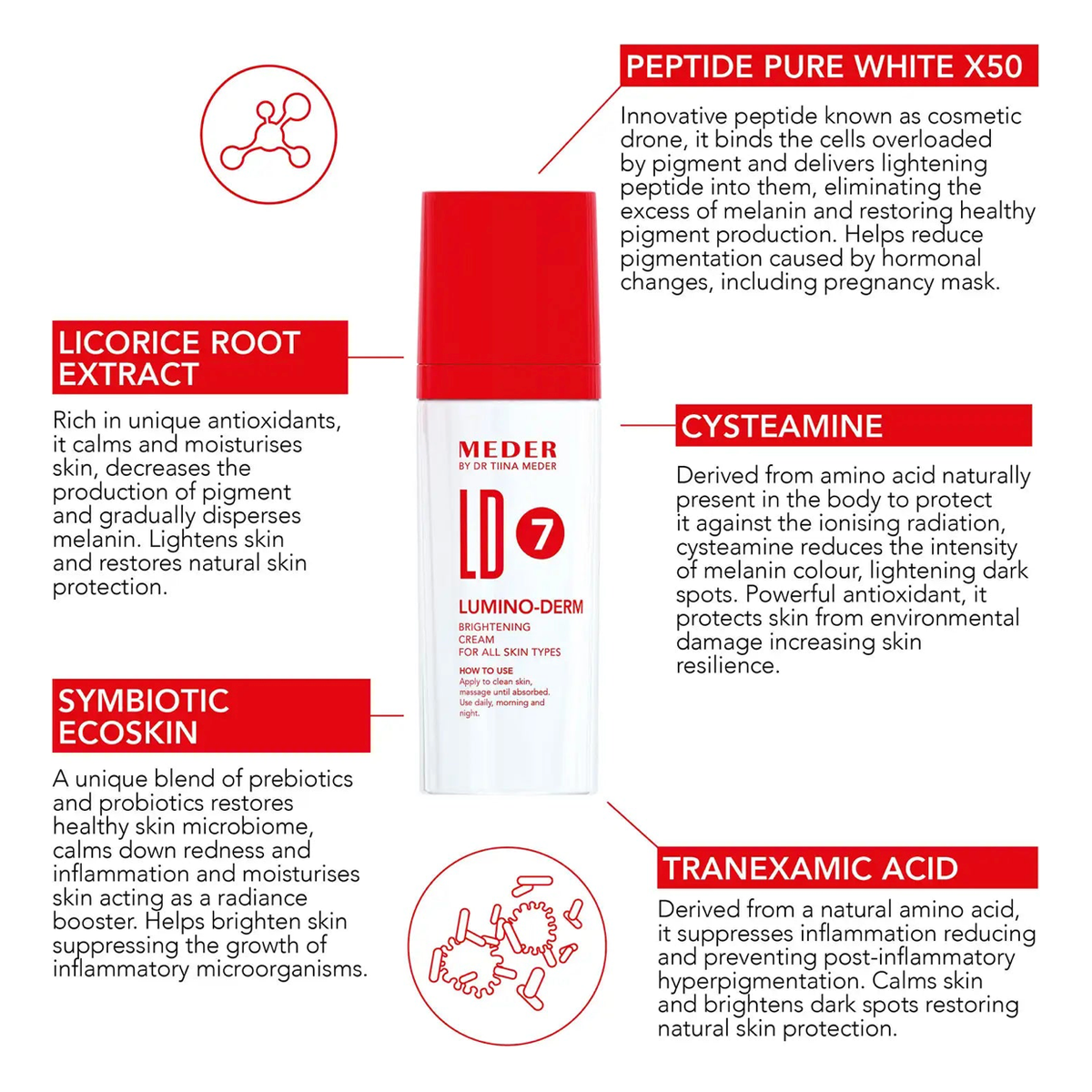
Cysteamine helps reduce the intensity of excess melanin and provides antioxidant support.

Tranexamic acid helps address inflammation-related pathways involved in pigmentation.

X50® Pure White peptide technology is designed to target pigment-loaded cells and influence melanin production more selectively.

Licorice root extract provides additional brightening, calming and antioxidant support.

Symbiotic Ecoskin® supports the microbiome and helps create a healthier, calmer skin environment.

And the cream base provides hydration and nourishment while all of this is happening.

So we're not relying on one heroic ingredient.

We're approaching pigmentation from several directions:

existing pigment

new pigment formation

inflammation

oxidative stress

microbiome balance

skin resilience.

That's why Lumino-Derm is much more interesting to me than simply putting a strong exfoliating acid on every dark spot.


BRIGHTENING DOES NOT MEAN WHITENING

This distinction matters enormously.

The purpose of Lumino-Derm is not to make naturally darker skin lighter.

And I would never want a client reading "brightening" and thinking their natural skin colour is something that needs correcting.

Melanin is normal.

Your natural skin tone is normal.

What we're treating is uneven or excessive pigment.

So when I say "brightening," I mean:

reducing unwanted dark spots.

improving uneven tone.

restoring luminosity.

reducing dullness.

and allowing your natural complexion to look clearer.

Think:

more even — not more white.

That's the goal.


WHAT IS MELASMA?

Melasma is a particularly stubborn form of pigmentation that usually appears as irregular brown or grey-brown patches.

Common areas include:

the forehead.

cheeks.

upper lip.

nose.

and sometimes the jawline.

Hormones play an important role, which is why melasma is often associated with:

pregnancy.

hormonal contraception.

and other hormonal changes.

But UV exposure is also a major trigger.

And increasingly, we understand that inflammation, heat and vascular factors can contribute too.

That's why melasma can be frustrating.

You may improve it beautifully and then suddenly see it return after sun exposure or another trigger.

So with melasma, I don't like promising:

“We'll erase it forever.”

A more realistic goal is:

control → reduce → prevent → maintain.

Lumino-Derm can be an excellent part of that strategy.


WHAT IS POST-INFLAMMATORY HYPERPIGMENTATION?

Post-inflammatory hyperpigmentation — or PIH — is the dark mark that can remain after inflammation has disappeared.

A classic example is acne.

The spot heals.

The swelling disappears.

But you're left with a brown, grey or dark mark that seems to stay forever.

That mark isn't necessarily a scar.

Often, it's pigment produced in response to the inflammation.

PIH can also follow:

skin picking.

eczema.

irritation.

burns.

aggressive treatments.

or other forms of skin injury.

And this is exactly why I'm cautious about overly aggressive pigmentation treatments.

If your skin responds to inflammation by producing more pigment, repeatedly irritating it can become completely counterproductive.

With PIH, calming the skin is part of treating the pigmentation.


PIGMENTATION OR ACNE SCAR?

These are not always the same thing.

If a blemish heals and leaves a flat brown or grey mark, we're often dealing with post-inflammatory pigmentation.

If it leaves a red or pink mark, there may be more of a vascular component.

If it leaves an actual indentation or raised area, we're dealing with structural scarring.

Lumino-Derm is primarily a pigmentation treatment.

It can help with the dark colour left after acne.

It cannot physically rebuild a deep indented acne scar.

That's a different problem and may require professional treatment.

Knowing the difference prevents us expecting the wrong product to do the wrong job.


HOW TO USE LUMINO-DERM

Lumino-Derm is your moisturising cream, not an additional serum.

MEDER recommends replacing your usual morning and evening moisturiser with Lumino-Derm during the targeted pigmentation programme.

A typical routine might look like:

Energy-Net → Energy-Soin → targeted Active Care if needed → Lumino-Derm

STEP 1 — CLEANSE

Start with the MEDER cleanser appropriate for your skin.

Energy-Net for most non-sensitive skin.

Net-Apax when sensitivity and redness are concerns.

STEP 2 — APPLY YOUR EVERYDAY SERUM

Use Energy-Soin or Soin-Apax according to your skin.

Allow it to absorb.

STEP 3 — APPLY YOUR ACTIVE CARE, IF USING ONE

If Vita-Long 2.0 or another MEDER Active Care product forms part of your programme, apply it before your cream.

STEP 4 — APPLY LUMINO-DERM

Apply Lumino-Derm evenly over the face and neck.

Don't only dab it onto individual dark spots unless we've specifically designed your routine that way.

Pigmentation is often influenced by processes happening beyond the visible border of the spot.

STEP 5 — SPF IN THE MORNING

During the day, follow with appropriate broad-spectrum sun protection.

This step is absolutely essential when pigmentation is the concern.


HOW OFTEN SHOULD I USE IT?

Lumino-Derm is designed to be used twice daily — morning and evening.

MEDER recommends a minimum course of approximately 5–10 weeks.

And consistency matters enormously.

Pigmentation doesn't respond particularly well to:

Monday — use cream.

Tuesday — forget.

Wednesday — use something else.

Thursday — aggressive peel.

Friday — nothing.

Saturday — sit in the sun.

Sunday — wonder why the pigmentation hasn't improved.

We need consistency.

Morning + evening + SPF + patience.

That combination matters much more than constantly changing products.


YOUR MORNING ROUTINE

1. Energy-Net / Net-Apax

2. Energy-Soin / Soin-Apax

3. Targeted Active Care if prescribed

4. Lumino-Derm

5. SPF

And yes:

SPF is still necessary.

We'll come back to that because it is probably the single most important rule on this entire page.


YOUR EVENING ROUTINE

If you're wearing substantial makeup:

1. Remove your makeup

2. Energy-Net / Net-Apax

3. Energy-Soin / Soin-Apax

4. Targeted Active Care if prescribed

5. Lumino-Derm

That's it.

Pigmentation routines do not have to involve twelve different acids and three exfoliating toners.

Sometimes a calm, consistent programme is far more intelligent.


WHAT'S INSIDE IT?

Lumino-Derm has a particularly interesting combination of established pigmentation ingredients and newer biotechnology.

CYSTEAMINE

Cysteamine is derived from an amino-acid-related compound naturally present within the human body.

In pigmentation skincare, we're interested in it because it can interfere with several processes involved in melanin formation and pigment intensity.

It's also an antioxidant.

Cysteamine has become increasingly interesting in dermatological pigmentation care because it gives us another option beyond traditional hydroquinone-based approaches.

In Lumino-Derm, it's incorporated into a broader brightening formula rather than being asked to do everything alone.

For you, the important takeaway is:

cysteamine helps reduce unwanted excess pigment without trying to remove your natural skin colour.


TRANEXAMIC ACID

Tranexamic acid has become one of the most interesting ingredients in modern pigmentation skincare.

Despite the word "acid," don't think of it as an exfoliating acid like glycolic acid.

That's not its main role here.

Tranexamic acid influences biological pathways connected with inflammation and melanin production.

That makes it particularly interesting for:

melasma.

post-inflammatory pigmentation.

and pigmentation influenced by inflammatory signalling.

This fits beautifully with the philosophy behind Lumino-Derm:

Sometimes the answer to pigmentation isn't exfoliate harder.

Sometimes it's calm the signals telling the skin to produce excess pigment.


WHY IS TRANEXAMIC ACID PARTICULARLY INTERESTING FOR MELASMA?

Because melasma isn't simply excess pigment sitting on the surface.

Hormonal and inflammatory signalling play important roles in its development.

Tranexamic acid has attracted considerable attention precisely because it interacts with pathways involved in that process.

That doesn't mean every case of melasma will disappear.

Melasma is notoriously complex and recurrent.

But it gives us a way of approaching the biological trigger, rather than simply trying to scrub away the visible colour.

That's a much more sophisticated strategy.


X50® PURE WHITE PEPTIDE

This is probably the most futuristic-sounding part of the formula.

MEDER describes X50® Pure White as a “cosmetic drone” delivery system.

I don't expect you to know what that means.

The basic idea is targeted delivery.

The technology is designed to preferentially deliver a brightening peptide toward cells associated with excess pigment.

That peptide then helps regulate signalling involved in melanin production.

Think of it less as:

bleach everything

and more as:

deliver the message where excessive pigment activity is happening.

That's the interesting part.

We're trying to become more selective about pigmentation treatment rather than indiscriminately attacking the entire skin surface.


LICORICE ROOT EXTRACT

Licorice root has a long history in calming and brightening skincare.

It contains antioxidant compounds that can help:

calm inflammation

support a more even skin tone

reduce excessive pigment activity

and protect the skin against environmental stress.

I particularly like licorice in pigmentation formulas because it supports both sides of the problem:

pigment + inflammation.

Again, that becomes especially useful when we're dealing with reactive skin or post-inflammatory marks.


SYMBIOTIC ECOSKIN®

Ecoskin® combines prebiotic and probiotic-derived support for the skin microbiome.

Why put microbiome support into a pigmentation cream?

Because inflammation and microbiome imbalance can influence the overall skin environment.

And if inflammation contributes to pigment production, keeping the skin calm and resilient becomes part of our brightening strategy.

This is something MEDER does very consistently across the range.

We don't treat:

pigmentation.

acne.

sensitivity.

ageing.

as though they're happening on a sterile sheet of skin.

The microbiome is part of the picture too.


SHEA BUTTER

With all the sophisticated pigmentation ingredients, it's easy to overlook the simple job of keeping the skin comfortable.

Shea butter provides emollient and lipid support.

This helps maintain softness and barrier comfort while we're carrying out the pigmentation programme.

And I think that's important.

A brightening cream shouldn't leave your skin feeling punished.

We want:

active treatment + comfortable skin.

Not:

active treatment + constant peeling + irritation.


DOES LUMINO-DERM CONTAIN HYDROQUINONE?

No.

Lumino-Derm is hydroquinone-free.

Hydroquinone is a well-established depigmenting ingredient used in dermatology, but it isn't the only way to approach pigmentation.

Lumino-Derm instead combines ingredients including:

cysteamine.

tranexamic acid.

targeted peptide technology.

licorice.

and microbiome support.

I don't think we need to turn this into:

hydroquinone = bad, Lumino-Derm = good.

That's far too simplistic.

Prescription pigmentation treatments absolutely have their place and can be extremely useful under appropriate medical supervision.

Lumino-Derm simply gives us a different cosmetic approach, particularly when we want something suitable for ongoing homecare without hydroquinone.


DOES IT CONTAIN RETINOL?

No.

Lumino-Derm is also retinol-free.

That's useful for clients who want to address pigmentation but don't tolerate retinoids well or don't want a retinoid-based routine.

Again, this doesn't mean retinol is bad.

Retinoids can be extremely useful in pigmentation and age-management programmes.

But they're not the only option.

Lumino-Derm uses a different strategy.


WILL LUMINO-DERM MAKE MY SKIN SUN-SENSITIVE?

MEDER states that Lumino-Derm does not increase photosensitivity.

That means the formula isn't designed to make your skin more vulnerable to sunlight in the way some aggressive exfoliating programmes can.

It can therefore be used throughout the year, including during sunnier periods.

But please don't misunderstand this.

Not photosensitising does NOT mean you can skip SPF.

If pigmentation is your concern, UV protection remains one of the most important parts of the entire treatment.


IF IT DOESN'T CAUSE SUN SENSITIVITY, WHY DO I STILL NEED SPF?

Because sunlight itself is one of the major triggers for pigmentation.

Your melanocytes don't care that you've bought a very good pigmentation cream.

If they continue receiving strong UV signals, they're still being encouraged to produce pigment.

Think of it this way:

Lumino-Derm is trying to tell the skin:

“Let's calm down this excessive pigment production.”

Unprotected UV exposure is simultaneously telling it:

“Produce more pigment.”

Those two messages are working against one another.

So SPF isn't simply an optional extra added to the end of the routine.

It's part of the pigmentation strategy itself.


DOES LUMINO-DERM REPLACE SPF?

Absolutely not.

Lumino-Derm may help improve the skin's resilience to UV-related stress, but it is not a sunscreen.

It doesn't replace a properly formulated broad-spectrum SPF.

The morning order is:

Lumino-Derm → SPF

Every time.


CAN I USE LUMINO-DERM IN SUMMER?

Yes.

MEDER specifically designed it so that it can be used during sunny periods without increasing photosensitivity.

And this is actually very useful.

Pigmentation doesn't politely disappear between June and August.

For many clients, summer is exactly when their pigmentation becomes more active.

So being able to maintain a brightening programme without deliberately sensitising the skin is a major advantage.

But summer use makes consistent sun protection even more important.

Hat.

Shade.

SPF.

Reapplication when appropriate.

Skincare and behaviour need to work together.


CAN I USE LUMINO-DERM DURING PREGNANCY?

MEDER states that Lumino-Derm is suitable during pregnancy and breastfeeding.

This is particularly relevant because pregnancy can trigger hormonal pigmentation commonly called the “pregnancy mask” or melasma.

Lumino-Derm doesn't contain retinol or hydroquinone, and MEDER specifically positions the formula as pregnancy-safe.

As always, if you're pregnant, breastfeeding, under medical care or using prescription products, you're welcome to have your complete skincare routine reviewed with your healthcare professional.


CAN I USE LUMINO-DERM ON POST-ACNE MARKS?

Yes — particularly when the mark is brown or dark and flat.

That's classic territory for post-inflammatory hyperpigmentation.

But here's something equally important:

If you're still getting significant active acne, we need to control the inflammation creating the marks as well.

Otherwise we're doing:

new breakout → new inflammation → new pigmentation → brighten mark → new breakout → repeat.

That's not efficient.

In that situation, we may need to combine pigmentation management with an appropriate acne programme.

Treat the cause and the consequence.


CAN I USE LUMINO-DERM ON JUST ONE DARK SPOT?

You can target specific areas, but I generally prefer thinking about pigmentation as part of the whole skin environment.

The skin immediately surrounding a visible spot may already be experiencing changes in pigment signalling even if you can't see them yet.

Applying Lumino-Derm evenly also helps improve overall tone and reduces the risk of creating an obvious contrast between one treated spot and untreated surrounding skin.

Remember:

we want an even complexion.

Not one pale circle where a dark spot used to be.


WILL MY DARK SPOTS DISAPPEAR COMPLETELY?

Some pigmentation may improve dramatically.

Other pigmentation may remain partially visible.

And some types — particularly melasma — can be recurrent.

How much improvement you get depends on:

the type of pigmentation.

how deep the pigment sits.

how long it has been present.

your skin tone.

your hormonal environment.

UV exposure.

inflammation.

medications.

and how consistently you follow the programme.

So I don't promise:

“Every dark spot will disappear forever.”

What we're aiming for is:

lighter pigmentation

more even tone

less contrast between dark areas and surrounding skin

brighter complexion

and better control of new pigment formation.

That's a much more realistic promise.


WHEN WILL I SEE A DIFFERENCE?

Pigmentation requires patience.

MEDER recommends using Lumino-Derm morning and evening for at least 5–10 weeks.

Some mild brightening may begin to appear earlier, but meaningful improvement generally requires consistent use over several weeks.

And please don't evaluate pigmentation day by day.

Lighting changes.

Your skin hydration changes.

Sun exposure changes.

Even the camera on your phone changes the way pigmentation appears.

Take a photograph before starting:

same room.

same position.

same lighting.

no makeup.

Then compare again several weeks later.

That's a much more useful way to judge progress.


WHY CAN PIGMENTATION SOMETIMES LOOK DARKER BEFORE IT LOOKS BETTER?

Pigment doesn't all sit at exactly the same depth.

As skin renews, pigment that was previously sitting deeper can gradually move towards the surface.

That can sometimes make certain areas appear temporarily more noticeable.

But significant new darkening, irritation, redness or discomfort should never simply be dismissed as:

"It's working."

I don't believe in that mentality.

If your skin becomes irritated or pigmentation is clearly worsening, we reassess.

Effective skincare doesn't require you to ignore what your skin is telling you.


LUMINO-DERM OR DERMA-FILL?

Very different jobs.

CHOOSE LUMINO-DERM IF...

The main concern is:

pigmentation

dark spots

melasma

PIH

sun spots

uneven skin tone.

Think:

BRIGHTEN + EVEN.

CHOOSE DERMA-FILL IF...

The main concern is:

dehydration

lightweight hydration

fine dehydration lines

surface plumping

or you need an extra hydrating layer.

Think:

HYDRATE + PLUMP.

If you have pigmentation and dehydration, we can build the routine accordingly rather than expecting one product to do absolutely everything.


LUMINO-DERM OR VITA-LONG 2.0?

Again, they address different priorities.

LUMINO-DERM

Targets pigmentation and uneven tone.

VITA-LONG 2.0

Targets broader skin longevity, resilience and age-related biological changes.

They can make sense within the same overall programme when both concerns are present.

Think:

Vita-Long = longevity support

Lumino-Derm = pigment correction


LUMINO-DERM CREAM OR LUMINO-DERM MASK?

These products complement each other, but they are not identical.

LUMINO-DERM CREAM

This is your daily pigmentation treatment and moisturiser.

Morning and evening.

Consistent.

Long-term.

LUMINO-DERM MASK

This is your intensive weekly brightening treatment.

It uses a different formula, including ingredients such as Melanostatine™ peptide, alpha-arbutin, resveratrol, gluconolactone and probiotic-derived support.

We'll cover the mask properly when we reach the mask section.

Think:

cream = daily pigment control

mask = intensive weekly brightening support.


WHAT SHOULD I USE BEFORE LUMINO-DERM?

Your exact routine depends on your skin, but a simple MEDER pigmentation routine may look like:

Energy-Net → Energy-Soin → Vita-Long 2.0 → Lumino-Derm

For sensitive skin:

Net-Apax → Soin-Apax → appropriate Active Care → Lumino-Derm

The important point is that Lumino-Derm replaces your usual face cream during the pigmentation programme.

It isn't another serum to squeeze somewhere between five other layers.

Keep the routine logical.


WHAT SHOULD I USE AFTER LUMINO-DERM?

At night?

Usually nothing else is necessary.

Lumino-Derm is already your moisturising cream.

During the day?

SPF.

That is the one product I absolutely want after it.

And if your pigmentation is significant, sunscreen use needs to be as consistent as the Lumino-Derm itself.

Because pigmentation treatment without UV protection is a little like trying to empty a bath while the tap is still running.

We need to work from both directions.


MY LUMINO-DERM RULES

If you remember nothing else from this page, remember these:

Brightening does not mean whitening.
We're restoring a more even version of your natural skin tone — not trying to change your ethnicity or natural colour.

Pigmentation has triggers.
UV, hormones, inflammation and skin injury can all influence melanin production.

Treat inflammation as well as pigment.
Especially when we're dealing with melasma or post-inflammatory marks.

Don't attack pigmentation aggressively just because it's stubborn.
More irritation can sometimes mean more pigment.

Use Lumino-Derm consistently.
Morning and evening for approximately 5–10 weeks as your moisturising cream.

Give it time.
Pigmentation develops gradually and usually fades gradually too.

Lumino-Derm is not SPF.
It does not replace sunscreen.

Not photosensitising does not mean sun-proof.
You still need appropriate UV protection.

A post-acne mark isn't necessarily a scar.
Flat dark marks are often pigmentation; indented scars are a different structural problem.

Melasma can come back.
The goal is often long-term control rather than promising permanent eradication.


THE BOTTOM LINE

Lumino-Derm is the cream I want you to think of when your goal isn't lighter skin — it's more even skin.

That's an important difference.

We're not fighting melanin.

Melanin belongs in your skin.

We're addressing situations where pigment production has become excessive, uneven or stuck in overdrive.

Sun exposure.

Hormones.

Inflammation.

Post-acne marks.

Melasma.

Environmental stress.

All of these can influence the pigmentation story.

So rather than simply exfoliating harder and hoping the dark spot eventually disappears, Lumino-Derm takes a more intelligent approach:

reduce excessive pigment

calm inflammatory signalling

support antioxidant defence

support the microbiome

maintain skin comfort

and help the complexion gradually return towards a clearer, more even version of its own natural colour.

That's what I want from a pigmentation cream.

Not bleached skin.

Not traumatised skin.

Not peeling for the sake of peeling.

Healthy skin that simply looks more even, luminous and clear.


LUMINO-DERM AT A GLANCE

What is it?
A targeted brightening moisturising cream designed to reduce unwanted pigmentation and restore a more even skin tone.

Best for:
Dark spots, melasma, sun spots, post-inflammatory hyperpigmentation, post-acne dark marks, hormonal pigmentation, sun damage and uneven skin tone.

Recommended age:
21+

Skin types:
All skin types, including sensitive skin.

How often?
Morning and evening.

How long?
Use consistently for at least 5–10 weeks. Pigmentation improvement develops gradually.

Where does it go in my routine?
After your serum and any targeted Active Care. Lumino-Derm replaces your usual moisturising cream.

Do I apply it only to dark spots?
It can be targeted, but generally I prefer applying it evenly over the area being treated to support a more uniform skin tone.

Does it contain retinol?
No.

Does it contain hydroquinone?
No.

Does it exfoliate my skin?
Its main strategy is pigment regulation, calming and brightening rather than aggressive exfoliation.

Will it make my skin lighter?
The aim is to reduce unwanted excess pigmentation and reveal a more even version of your natural skin tone — not to whiten naturally pigmented skin.

Is it suitable for melasma?
Yes. Melasma is one of the pigmentation concerns MEDER specifically targets with Lumino-Derm.

Can I use it for post-acne marks?
Yes, particularly flat brown or dark post-inflammatory marks. It will not physically repair indented acne scars.

Can it be used during pregnancy and breastfeeding?
MEDER states that Lumino-Derm is suitable during pregnancy and breastfeeding.

Can I use it during summer?
Yes. MEDER states that it doesn't increase photosensitivity, but appropriate daily sun protection remains essential.

Does it replace sunscreen?
Absolutely not.

Hero ingredients:
Cysteamine, tranexamic acid, X50® Pure White peptide technology, licorice root extract and Symbiotic Ecoskin® microbiome support.

What comes before it?
Cleanser → everyday serum → targeted Active Care if required.

What comes after it?
SPF during the day.

What can I add weekly?
Lumino-Derm Mask once or twice weekly when appropriate — we'll cover this separately in the mask section.

Size:
50 ml

View full details