Skip to product information
1 of 5

Meder Eu-Seb Anti-Acne Active Serum

Meder Eu-Seb Anti-Acne Active Serum

Order by request

Acne-prone skin doesn't need to be punished. It needs to be brought back into balance.

Eu-Seb is the targeted serum I reach for when we're dealing with breakouts, excess oil, congestion and enlarged-looking pores.

And I particularly like it because the philosophy behind it is very different from the traditional approach to acne.

For years, acne skincare was almost entirely about attacking the skin.

Strip away the oil.

Dry out the spots.

Kill the bacteria.

Exfoliate more.

Use something stronger.

And if your skin became dry, red and uncomfortable?

That was often treated as proof that the product was "working."

Eu-Seb takes a completely different approach.

Instead of trying to sterilise the skin, we're working with its microbiome — supporting the beneficial microorganisms while helping control the conditions associated with acne.

At the same time, we're working on excess sebum, inflammation, comedones and pore appearance.

I think of it as:

rebalance → regulate → calm → clear.


WHY I LIKE EU-SEB

Acne skin is often treated far too aggressively.

And I understand why.

When you're breaking out, you want the spots gone.

Now.

So it's incredibly tempting to scrub harder, cleanse more often, use stronger acids and apply anything promising to "dry out" a blemish.

But healthy skin is not supposed to be sterile.

Your skin naturally supports an enormous community of microorganisms, collectively known as the skin microbiome.

The goal isn't to destroy all bacteria.

It's to maintain the right balance.

Eu-Seb is built around that idea.

Its prebiotic system helps support a healthier microbiome while its plant-derived actives work on the factors associated with breakouts and excess sebum.

So we're not trying to win a war against your face.

We're trying to help acne-prone skin behave more normally.


WHAT DOES EU-SEB ACTUALLY DO?

There are several things happening at the same time.

First, we're working on the microbiome.

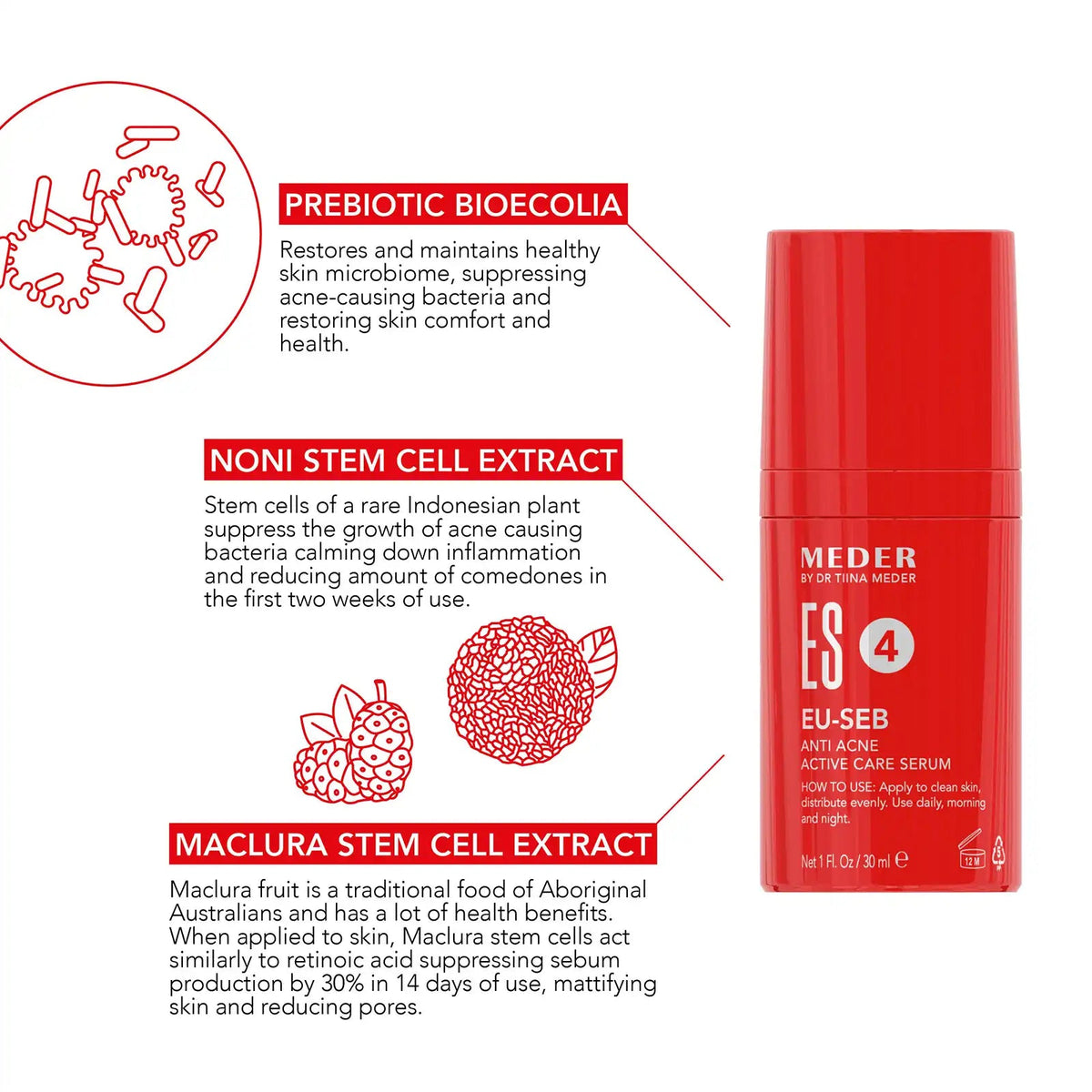
Eu-Seb contains the prebiotic Bioecolia®, which helps create conditions that favour beneficial microorganisms while helping suppress bacteria associated with acne.

Then we're addressing the breakout itself.

Noni stem-cell culture extract helps target acne-associated bacterial activity and inflammation, while also helping reduce comedones.

And finally, Maclura-derived bioflavonoids give us an interesting retinol-like action.

They help regulate excess sebum production, improve oiliness and reduce the appearance of enlarged pores — without relying on traditional retinoids.

So we're addressing:

breakouts

excess oil

comedones

inflammation

enlarged-looking pores

microbiome imbalance

without deliberately drying or irritating the skin.

That's what makes Eu-Seb different.


WHO IS EU-SEB FOR?

I particularly like Eu-Seb for skin that is:

Acne-prone
When recurring breakouts are one of our main concerns.

Oily
When excess sebum is contributing to shine, congestion and breakouts.

Congested
When blackheads, whiteheads and blocked pores are becoming persistent.

Showing enlarged-looking pores
Particularly when excess oil and congestion are making them more noticeable.

Experiencing hormonal or period-related breakouts
When blemishes appear predictably around hormonal changes.

Experiencing adult acne
Because acne is absolutely not something that belongs only to teenagers.

Affected by menopausal acne
When hormonal changes later in life suddenly bring breakouts back — sometimes after decades of relatively clear skin.

Affected by athlete's acne
When sweat, heat, friction and occlusion contribute to recurring breakouts.

Sensitive as well as acne-prone
When traditional aggressive acne products simply create more irritation.

And this last point matters.

You can have acne and sensitive skin at the same time.

We don't have to choose which one to care about.


ACNE ISN'T A HYGIENE PROBLEM

This is one thing I really want my acne clients to understand.

Having acne does not mean your skin is dirty.

And washing your face five times a day isn't going to solve it.

Acne is influenced by several factors, including sebum production, follicular blockage, inflammation, hormones and the activity of microorganisms within the skin.

So when we repeatedly scrub and strip acne-prone skin in an attempt to make it "cleaner", we can actually create a second problem:

an irritated, compromised skin barrier on top of the acne.

Now we're dealing with breakouts and sensitivity.

That's why I want cleansing to be thorough but gentle.

We're removing makeup, sunscreen, excess oil and daily impurities.

We're not trying to disinfect your face.


WHY DOES THE MICROBIOME MATTER IN ACNE?

One of the bacteria associated with acne is Cutibacterium acnes, usually shortened to C. acnes.

But here's where it gets interesting.

C. acnes can exist on healthy skin too.

So the story isn't simply:

bacteria = bad → kill all bacteria = clear skin.

The balance between different microorganisms and the environment in which they live matters enormously.

Certain conditions can allow acne-associated strains and microbial communities to become more problematic.

This is where MEDER's microbiome approach comes in.

Instead of trying to wipe everything out, Eu-Seb uses prebiotic support to help create conditions that favour a healthier microbial balance.

That's a much more intelligent way of thinking about acne than simply trying to sterilise the skin.


WHAT ABOUT BIOFILM?

This is another interesting part of chronic acne.

Microorganisms don't always exist as isolated individual cells sitting politely on the skin.

They can form organised communities surrounded by a protective matrix known as a biofilm.

You can think of biofilm almost like a protective neighbourhood that makes the microorganisms inside it more difficult to disturb.

This becomes particularly interesting when we're dealing with persistent or recurring acne.

MEDER's acne philosophy specifically considers the relationship between acne, microbial communication and biofilm formation.

So again, we're moving away from:

"How can I dry this spot out?"

towards the much more useful question:

"What is happening in the skin environment that keeps allowing these breakouts to return?"

That's a very different way of treating acne-prone skin.


HOW TO USE EU-SEB

Eu-Seb is a targeted active serum, so it comes after your everyday MEDER serum.

A typical acne/oily-skin routine may look like:

Net-Apax → Soin-Apax → Eu-Seb → Eu-Skin or Equa-Derm

STEP 1 — CLEANSE

Start with your appropriate MEDER cleanser.

For acne-prone or sensitive skin, Net-Apax is often a very natural choice.

Cleanse thoroughly but gently.

STEP 2 — APPLY YOUR EVERYDAY SERUM

Apply Soin-Apax or the everyday MEDER serum selected for your skin.

Allow it to absorb.

STEP 3 — APPLY EU-SEB

Apply a small amount of Eu-Seb evenly over the face.

Don't use it only as a tiny spot treatment unless I've specifically advised you to do so.

We're trying to improve the overall environment and behaviour of acne-prone skin, not simply chase individual spots around your face.

STEP 4 — ALLOW IT TO ABSORB

Give the serum a moment to settle into the skin.

There's no need for aggressive rubbing.

STEP 5 — FINISH YOUR ROUTINE

Follow with Eu-Skin when active acne treatment is the priority, or Equa-Derm when we need a microbiome-friendly moisturiser particularly suited to oily skin.

During the day, finish with appropriate sun protection.


HOW OFTEN SHOULD I USE IT?

Eu-Seb is designed to be used morning and evening.

MEDER recommends using it consistently for approximately 5–10 weeks.

And consistency really matters here.

I don't want you applying Eu-Seb only when a spot appears and stopping as soon as it disappears.

We're trying to improve the conditions that contribute to repeated breakouts.

That takes time.

Acne treatment is rarely about winning one battle against one blemish.

The real goal is:

fewer new breakouts appearing in the first place.


YOUR MORNING ROUTINE

1. Net-Apax
Cleanse gently without stripping the skin.

2. Soin-Apax
Your calming everyday serum when sensitivity and acne coexist.

3. Eu-Seb
Your targeted anti-acne active serum.

4. Eu-Skin or Equa-Derm
Selected according to what your skin needs.

5. SPF


YOUR EVENING ROUTINE

If you're wearing substantial makeup:

1. Remove your makeup

2. Net-Apax

3. Soin-Apax

4. Eu-Seb

5. Eu-Skin or Equa-Derm

And once or twice a week, we can introduce Enzy-Peel and/or Eu-Seb Mask when appropriate.

The exact routine depends on your skin.

Acne treatment should be structured — not aggressive.


WHY DOES EU-SEB NOT FEEL LIKE A TRADITIONAL ACNE TREATMENT?

Because we've been conditioned to associate acne treatment with discomfort.

Dryness.

Peeling.

Tightness.

Stinging.

Redness.

Sometimes clients start using Eu-Seb and almost wonder:

"Is this actually doing anything?"

because their face isn't being stripped.

That's a good thing.

Effective acne care does not need to make your skin miserable.

Eu-Seb is designed to work on the microbiome, sebum production and acne-associated processes without deliberately creating the irritation associated with many traditional acne actives.

"No pain, no gain" is not a skincare principle I want you following.


WHAT'S INSIDE IT?

The formula is relatively focused, but the three main components work from different angles.

PREBIOTIC BIOECOLIA®

Bioecolia® is an alpha-glucan oligosaccharide prebiotic.

And the easiest way to understand a prebiotic is to think of it as food for beneficial microorganisms.

Rather than simply trying to kill bacteria indiscriminately, Bioecolia® helps create conditions that favour the microorganisms we want while making the environment less favourable for those associated with acne.

MEDER reports that independent in-vitro testing of Eu-Seb demonstrated a significant reduction in acne-associated C. acnes activity.

But the important concept for you isn't the laboratory number.

It's this:

we're supporting balance rather than trying to sterilise the skin.


NONI STEM-CELL CULTURE EXTRACT

Noni comes from Morinda citrifolia, a plant traditionally used in parts of South and Southeast Asia and the Pacific.

Eu-Seb contains a cultured extract derived from Noni plant cells.

Its role within the formula is particularly relevant to breakouts, inflammation and comedones.

MEDER uses it to help suppress acne-associated bacterial activity while calming inflammation and reducing the number of blackheads and whiteheads.

So while Bioecolia® helps us work on the overall microbial environment, Noni gives us a more targeted action on the processes associated with active acne.


MACLURA BIOFLAVONOIDS

This is probably the ingredient clients find most interesting.

Maclura-derived bioflavonoids provide what MEDER describes as a retinoic-acid-like effect without using traditional retinol.

Their role is particularly focused on sebum regulation, pore appearance and oily skin.

MEDER reports reduced sebum production with regular use, helping the complexion become less oily and pores appear more refined.

So when we describe Eu-Seb as a natural retinol-like acne serum, this is largely what we're talking about.

We're getting some of the regulatory benefits we associate with retinoid-style acne care without making traditional retinoids the centre of the formula.


DOES EU-SEB CONTAIN RETINOL?

No.

Eu-Seb does not contain traditional retinol.

Its Maclura-derived bioflavonoids are used because they can produce a retinol-like effect on oily and acne-prone skin, particularly in relation to sebum regulation.

This distinction is important.

"Retinol-like" doesn't mean somebody has secretly put retinol into the bottle and renamed it.

It means we're using a different ingredient to influence some of the same skin concerns.

And for somebody who struggles with the irritation commonly associated with retinoids, that can be very interesting.


CAN I USE EU-SEB DURING PREGNANCY?

MEDER states that Eu-Seb is suitable for use during pregnancy and breastfeeding.

This is particularly useful because traditional retinoids are not appropriate during pregnancy.

And pregnancy doesn't necessarily mean your acne politely disappears.

Hormonal changes can actually make breakouts worse for some people.

Eu-Seb gives us a non-retinoid option for supporting acne-prone skin during this period.

That said, pregnancy skincare should always be considered as a whole, particularly if you're using prescription or medical acne treatment.

If you're unsure about anything you're using during pregnancy, check with your doctor or midwife.


CAN I USE EU-SEB WITH RETINOL OR ACIDS?

This is where I don't want us turning your bathroom into a chemistry experiment.

MEDER's updated Eu-Seb formulation can be used alongside retinol and AHAs without those ingredients cancelling its microbiome-normalising effect.

But that doesn't automatically mean you need all of them.

Eu-Seb already contains Maclura bioflavonoids with a retinol-like action.

So adding retinol, acids and multiple exfoliating treatments on top may simply create unnecessary irritation.

The question isn't:

"Can I technically combine these?"

The better question is:

"Does my skin actually need all of them?"

Often, it doesn't.


WHAT ABOUT ANTIBIOTIC ACNE TREATMENT?

If you're undergoing medical treatment for acne, particularly antibiotic-based therapy, don't simply stop prescribed medication because you're introducing skincare.

That decision belongs between you and your prescribing clinician.

What we can do is think carefully about microbiome support while the skin is undergoing treatment.

MEDER specifically positions Eu-Seb as useful for supporting the microbiome alongside acne therapy.

But skincare and prescription treatment have different roles.

If you're being treated medically for acne, I want the two approaches to work together, not compete with one another.


WILL EU-SEB DRY OUT MY SKIN?

That isn't the goal.

And this is one of the biggest differences between Eu-Seb and many traditional acne products.

We're trying to reduce excess sebum, not remove every trace of oil from your face.

Your skin needs lipids.

Your barrier needs protection.

If an acne treatment leaves your face painfully tight, flaky and irritated, we haven't necessarily created healthier skin.

We've potentially exchanged one problem for another.

With Eu-Seb, I want the skin to become:

less oily

less congested

calmer

clearer

without becoming stripped and uncomfortable.


WHAT SHOULD MY SKIN FEEL LIKE AFTERWARDS?

Comfortable.

Eu-Seb has a lightweight serum texture and shouldn't leave acne-prone skin feeling heavily coated.

Over time, I want you to notice:

less excessive shine

fewer new breakouts

less congestion

fewer blackheads and whiteheads

a calmer-looking complexion

pores appearing less noticeable

But I don't want you looking for tightness as proof that the product is controlling oil.

Skin doesn't need to feel dry to become better balanced.


WILL EU-SEB HELP WITH BLACKHEADS AND WHITEHEADS?

Yes — comedones are specifically one of the concerns Eu-Seb is designed to address.

Blackheads and whiteheads form when the follicle becomes clogged with a combination of sebum and keratinised material.

The difference is whether that blockage remains open to the air or closed beneath the surface.

By helping regulate sebum and supporting healthier acne-prone skin, Eu-Seb can help reduce the conditions contributing to recurring comedones.

But don't start aggressively squeezing everything you can see.

Managing congestion is one thing.

Creating inflammation and post-inflammatory marks with your fingernails is another.


WILL EU-SEB HELP WITH ACNE SCARS?

We need to separate active acne from what acne leaves behind.

Eu-Seb is primarily designed to address active acne, excess oil, comedones and the skin environment associated with breakouts.

If you're dealing with true indented or raised acne scars, those are structural changes in the skin and usually require a different treatment approach.

Post-inflammatory marks — the red or brown marks left behind after spots — are different again.

Those may gradually improve with time and appropriate skincare, but Eu-Seb isn't a dedicated scar-removal serum.

The first priority is often very simple:

stop creating new acne before we start treating what the old acne left behind.


WHEN WILL I SEE A DIFFERENCE?

Some changes can begin relatively quickly.

MEDER reports that its Noni culture can help reduce comedones within the first couple of weeks, while the Maclura component has demonstrated sebum reduction within approximately two weeks.

But acne is not something I want you judging after four days.

For the overall treatment, think in terms of 5–10 weeks of consistent use.

And don't only count the spots currently on your face.

Look at the pattern.

Are fewer new spots appearing?

Is your skin becoming less oily?

Are blackheads and whiteheads reducing?

Do breakouts settle more comfortably?

Does the skin generally look calmer?

That's how we evaluate progress.


EU-SEB SERUM OR EU-SEB MASK?

They belong to the same family, but they don't do exactly the same job.

EU-SEB ACTIVE SERUM

This is your daily targeted treatment.

It works on the microbiome, acne-associated bacteria, excess sebum, comedones and ongoing breakout control.

Use it morning and evening.

EU-SEB MASK

This is your intensive weekly support.

The mask focuses particularly on calming inflammation, reducing excess sebum and helping keep the complexion matte while creating a supportive environment for the microbiome.

MEDER recommends using the mask once or twice a week, alongside daily Eu-Seb serum.

So one doesn't replace the other.

The serum does the everyday work.

The mask gives us an additional weekly treatment.


WHAT SHOULD I USE AFTER EU-SEB?

This depends on what your acne-prone skin needs.

If active acne is the main concern, Eu-Skin is the natural next step.

If your skin is primarily oily, shiny and congestion-prone, Equa-Derm may be the better moisturiser.

And yes — oily and acne-prone skin still needs moisturiser.

Skipping moisturiser because you're afraid of oil is one of those habits that can make acne routines unnecessarily harsh.

We choose the right moisturiser, rather than eliminating moisturiser completely.

A typical routine might be:

Net-Apax → Soin-Apax → Eu-Seb → Eu-Skin / Equa-Derm

Then we adjust according to your actual skin.


MY EU-SEB RULES

If you remember nothing else from this page, remember these:

Acne does not mean dirty skin.
More washing and harder scrubbing won't solve the underlying problem.

Don't try to sterilise your face.
Healthy skin needs a balanced microbiome.

Use Eu-Seb consistently.
Morning and evening for approximately 5–10 weeks gives us a proper treatment period.

Don't use it only as a spot treatment.
We're working on the overall environment of acne-prone skin.

Oil isn't the enemy.
We're regulating excessive sebum, not trying to remove every lipid from the skin.

Don't chase irritation.
Burning, peeling and tightness are not proof that acne treatment is working.

Don't automatically pile on acids and retinol.
More active ingredients do not automatically mean faster results.

Don't squeeze.
Turning a blocked pore into an inflamed wound increases your risk of prolonged redness, pigmentation and scarring.

Give acne treatment time.
Look at the pattern of new breakouts over several weeks rather than judging your skin day by day.


THE BOTTOM LINE

Eu-Seb is the serum I want you to think of when we're treating acne without declaring war on your skin.

We're not trying to dry your face until nothing can survive on it.

We're working with the microbiome.

We're helping control acne-associated bacteria.

We're regulating excess sebum.

We're reducing congestion.

And we're trying to create an environment where healthy skin microorganisms can thrive while acne becomes less able to dominate the conversation.

That's what I like about the MEDER approach to acne.

The goal isn't:

dry skin with fewer spots.

It's:

healthier, calmer, clearer and better-balanced skin.

Because acne-prone skin still deserves to be treated like skin, not like a problem that needs to be scrubbed away.


EU-SEB AT A GLANCE

What is it?
A targeted microbiome-focused active serum for oily and acne-prone skin.

Best for:
Acne, excess oil, blackheads and whiteheads, enlarged-looking pores, period breakouts, adult acne, menopausal acne and athlete's acne.

How often?
Morning and evening.

How long?
Approximately 5–10 weeks for a targeted programme.

Where does it go in my routine?
After your everyday MEDER serum and before your moisturiser or targeted cream.

Does it contain retinol?
No. It contains Maclura-derived bioflavonoids with a retinol-like action.

Will it dry out my skin?
That's not the goal. Eu-Seb is designed to regulate excess sebum without relying on the aggressive drying approach of many traditional acne treatments.

Can I use it during pregnancy and breastfeeding?
MEDER states that Eu-Seb is suitable during pregnancy and breastfeeding.

Can I combine it with retinol or acids?
The current formula can be used alongside them, but that doesn't mean your skin necessarily needs the combination. We decide according to your complete routine.

Does it treat acne scars?
Its primary role is active acne, oiliness, congestion and microbiome balance rather than correction of established structural acne scars.

Hero ingredients:
Prebiotic Bioecolia®, Noni stem-cell culture extract and Maclura-derived bioflavonoids.

What comes next?
Eu-Skin for active acne or Equa-Derm when oily-skin moisturising and microbiome support are the priority, plus SPF during the day.

What can I add weekly?
Eu-Seb Mask once or twice weekly, and Enzy-Peel when appropriate for your skin.

Size:
30 ml

View full details