Skip to product information
1 of 3

Meder Equa-Derm Sebum-Balancing Moisturiser for Oily & Combination Skin

Meder Equa-Derm Sebum-Balancing Moisturiser for Oily & Combination Skin

Order by request

Oily skin doesn't need to be dried out. It needs to learn how to behave more normally.

Equa-Derm is the MEDER cream I reach for when the main problem is excessive oil production, persistent shine, enlarged-looking pores or oily and combination skin that never seems properly balanced.

And the word balanced is important.

Because the goal isn't to make oily skin dry.

It isn't to remove every trace of sebum.

And it definitely isn't to leave your face feeling tight, squeaky and uncomfortable.

Sebum is supposed to be there.

Your skin needs it.

The problem begins when the sebaceous glands are producing more than the skin actually needs.

Equa-Derm is designed to help regulate that excess while keeping the skin hydrated, comfortable and supported.

I think of it as:

regulate → calm → hydrate → refine → balance.


WHY I LIKE EQUA-DERM

Oily skin has been mistreated for years.

Strip it.

Scrub it.

Dry it.

Degrease it.

Use alcohol.

Skip moisturiser.

Exfoliate again.

And when the skin becomes irritated and dehydrated?

Dry it out some more.

I don't like that approach.

Because oily skin is still skin.

It still needs:

water.

barrier protection.

a healthy microbiome.

antioxidant defence.

and appropriate moisturisation.

What it doesn't necessarily need is more oil.

Equa-Derm allows us to moisturise oily skin while simultaneously addressing the reason the client doesn't want to use moisturiser in the first place:

too much sebum.

That's what makes it useful.

We're not choosing between treating oiliness and keeping the skin healthy.

We're doing both.


WHO IS EQUA-DERM FOR?

I particularly like Equa-Derm for skin that is:

Oily
When the face becomes shiny relatively quickly after cleansing.

Combination
Particularly when the forehead, nose and chin are oily while the rest of the face behaves more normally.

Excessively shiny
When makeup and SPF seem to disappear into oil by lunchtime.

Congestion-prone
When excess sebum contributes to blocked pores and uneven texture.

Large-pored in appearance
Particularly when pores appear more obvious through the central face.

Oily and breakout-prone
When excess sebum forms part of the acne picture.

Adult oily skin
Because oiliness and breakouts aren't exclusively teenage problems.

Hormonal or menopausal oily skin
When changes in hormones are influencing sebaceous activity and breakouts later in life.

Oily but sensitive
When traditional mattifying or acne products create too much irritation.

Oily in hot or humid weather
When your usual moisturiser suddenly feels too rich.

And importantly:

You don't need acne to use Equa-Derm.

You may simply have oily skin.

That's enough.


FIRST — SEBUM IS NOT THE ENEMY

Sebum is the oily substance produced by your sebaceous glands.

And despite everything you've probably been told about "getting rid of oil," sebum has useful functions.

It helps:

keep the skin flexible.

support the protective surface barrier.

reduce excessive water loss.

and contribute to the skin's natural protective environment.

So I don't want to eliminate it.

Skin without enough sebum becomes dry and vulnerable.

The problem is excess.

When sebaceous glands become overactive, we can see:

persistent shine.

greasy texture.

more visible pores.

congestion.

comedones.

and, in some people, acne.

So Equa-Derm isn't trying to switch the sebaceous glands off.

We're trying to bring them closer to normal activity.


WHY IS MY SKIN SO OILY?

There isn't one answer.

Sebum production can be influenced by:

Genetics
Some people naturally have more active sebaceous glands.

Hormones
Androgens strongly influence sebum production, which is why oiliness can change during puberty, menstrual cycles, pregnancy, perimenopause and other hormonal shifts.

Stress
Stress-related hormonal signalling can influence inflammation and sebaceous activity.

Climate
Hot and humid environments often make oiliness feel much more noticeable.

Age
Sebum production changes throughout life — and adult or menopausal acne can absolutely occur.

Skincare
Overly aggressive routines can leave oily skin dehydrated, irritated and barrier-impaired.

So if you've spent years asking:

"How do I remove all this oil?"

I want to change the question.

Let's ask:

"Why is the skin producing this much oil, and how can we help it function more normally?"

That's a much more useful starting point.


OILY SKIN STILL NEEDS MOISTURISER

This is probably the biggest lesson on this page.

Yes.

Oily skin needs moisturiser.

Your sebaceous glands produce oil.

They don't produce all the water your skin needs to remain properly hydrated.

So your skin can be simultaneously:

oily + dehydrated.

And this combination is extremely common.

The face looks shiny.

But after cleansing, it feels tight.

Foundation catches around the mouth.

Fine dehydration lines appear.

The skin may even sting.

Yet two hours later, the T-zone is oily again.

That's not healthy, beautifully balanced oily skin.

That's often oily skin with a hydration or barrier problem layered on top of it.

Equa-Derm lets us moisturise without unnecessarily adding a heavy, greasy finish.


DOES DEHYDRATION CAUSE MORE OIL?

This needs a little nuance.

You'll often hear:

"If you dry out oily skin, it produces more oil to compensate."

The biology isn't quite that simple.

Sebaceous glands don't instantly detect surface dehydration and automatically switch themselves into emergency oil-production mode.

Sebum production is much more strongly influenced by factors such as genetics and hormones.

But aggressive drying routines can absolutely make oily skin worse overall.

Why?

Because you create:

dehydration.

barrier damage.

inflammation.

sensitivity.

rough texture.

and an uncomfortable combination of tightness and surface oil.

So the lesson is still correct:

don't try to cure oily skin by damaging it.

We want less excessive oil and healthier skin.


WHAT DOES EQUA-DERM ACTUALLY DO?

Equa-Derm works on several of the problems associated with oily skin at the same time.

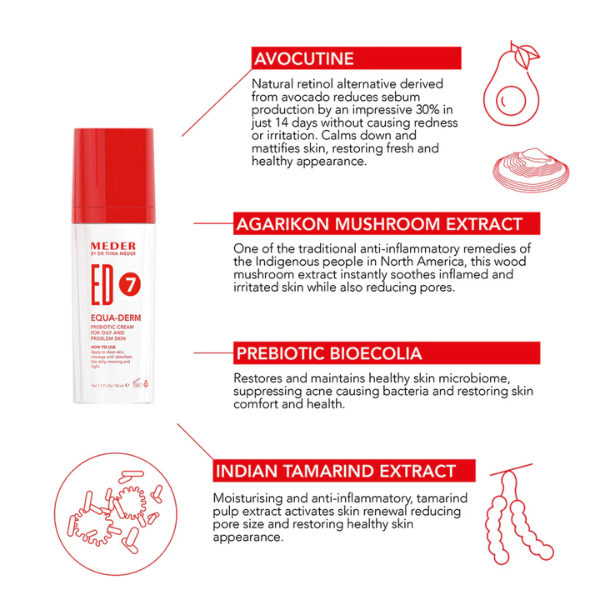
Avocutine® / Butyl Avocadate helps regulate excessive sebum production.

Agarikon Mushroom Extract provides soothing and astringent support, helping improve the appearance of enlarged pores and irritated oily skin.

Bioecolia® Prebiotic supports a healthier skin microbiome.

Indian Tamarind Seed Extract provides hydration and calming support while helping improve skin texture.

And the overall lightweight formula moisturises without giving oily skin the heavy, occlusive feeling many clients dislike.

So we're addressing:

excess oil

visible shine

inflammation

pore appearance

hydration

and microbiome balance.

That's why I prefer the word balancing to simply "mattifying."

Mattifying tells me what the skin looks like.

Balancing tells me what we're actually trying to achieve.


WHAT DOES “MATTIFYING” ACTUALLY MEAN?

A mattifying product reduces the appearance of unwanted surface shine.

That's useful.

But I don't want your face to look completely flat and lifeless.

There is a difference between:

greasy shine

and

healthy luminosity.

Greasy shine usually comes from excess sebum sitting on the surface.

Healthy luminosity comes from smooth, well-hydrated skin reflecting light evenly.

Our goal with Equa-Derm is:

less greasy shine — not less healthy glow.

Your skin should still look alive.


WHAT ABOUT PORES?

Let's clear up another skincare myth.

You cannot literally open and close pores like tiny doors.

Pores don't have muscles controlling them that way.

But their appearance can absolutely change.

A pore may look more noticeable when:

sebum production is high.

the opening becomes congested.

skin texture is uneven.

or structural support around the pore changes with age and sun exposure.

So when Equa-Derm reduces excess sebum and improves the surrounding skin environment, pores can appear smaller, cleaner and less obvious.

That's what I mean when I say "refining pores."

We're improving their appearance.

We're not physically deleting them.

And we shouldn't want to.

Pores are normal skin anatomy.


WHY DO OILY SKIN AND LARGE-LOOKING PORES OFTEN COME TOGETHER?

Sebaceous glands empty their sebum onto the skin through follicles.

When those glands are particularly active, the follicular opening can become more noticeable.

Add congestion and accumulated sebum and the pore may appear even larger.

That's why controlling excessive oil production can make such a visible difference to skin texture.

Less excessive sebum.

Less congestion.

Smoother-looking surface.

Less obvious pores.

Again, we're not "closing" them.

We're making them less visually dominant.


WHAT ABOUT BLACKHEADS?

Blackheads are open comedones.

They develop when a pore becomes blocked with a mixture of sebum and dead skin material.

The dark colour isn't dirt.

The material at the surface oxidises when exposed to air, creating the characteristic darker appearance.

So please don't attack blackheads because you think your face is dirty.

Excess sebum can contribute to their formation, which is why sebum regulation can help.

But if significant comedonal acne is present, Equa-Derm alone may not be enough.

That's when products such as Eu-Seb and Eu-Skin become more relevant.

Equa-Derm controls the oily environment.

The acne programme addresses the acne itself.


OILY SKIN OR ACNE — THEY'RE NOT THE SAME THING

This distinction is very important.

You can have:

oily skin without acne

and

acne without extremely oily skin.

Acne is a complex inflammatory condition involving factors such as:

sebum.

follicular blockage.

microbial changes.

inflammation.

and hormonal influence.

So Equa-Derm shouldn't automatically be described as "the acne cream."

It's primarily the oily-skin moisturiser.

If acne is the dominant problem, we may need the more targeted MEDER acne programme.

That might include:

Eu-Seb Active Serum

and/or

Eu-Skin Cream.

We choose according to what the skin is actually doing.


EQUA-DERM OR EU-SKIN?

This is probably the most important product comparison on this page.

Both can make sense for oily and acne-prone skin.

But their priorities are different.

EQUA-DERM

I choose Equa-Derm when the dominant concern is:

excessive oil

persistent shine

visible pores

oily or combination skin

with or without occasional breakouts.

Think:

CONTROL THE OIL.

EU-SKIN

I choose Eu-Skin when the dominant concern is:

active acne

comedones

inflammatory breakouts

including more persistent acne.

Think:

TREAT THE ACNE.

If you're oily and have a few occasional blemishes, Equa-Derm may be enough as your moisturiser.

If you're dealing with significant active acne, Eu-Skin may be the more appropriate targeted cream.

The fact that two products are both suitable for oily skin doesn't mean they do exactly the same job.


EQUA-DERM OR EU-SEB?

Again, these are different steps.

EU-SEB

Eu-Seb is a targeted Active Serum.

Its focus is the acne-prone skin environment, microbiome balance and reducing acne-associated bacterial and inflammatory activity.

It goes before your cream.

EQUA-DERM

Equa-Derm is your moisturiser.

Its primary role is regulating excess sebum, mattifying, hydrating and supporting oily skin.

So a very logical MEDER oily-skin routine is:

Cleanser → Eu-Seb → Equa-Derm

They complement each other rather than compete.


HOW TO USE EQUA-DERM

Equa-Derm is your moisturising step.

MEDER recommends using it morning and evening on clean skin.

A typical oily-skin routine may look like:

Energy-Net / Net-Apax → Energy-Soin / Soin-Apax → Eu-Seb → Equa-Derm

STEP 1 — CLEANSE

Use the MEDER cleanser appropriate for your sensitivity level.

And please resist the temptation to choose the harshest cleanser possible simply because you're oily.

Clean skin should feel:

clean.

Not:

stripped.

STEP 2 — APPLY YOUR EVERYDAY SERUM

Use Energy-Soin or Soin-Apax according to your skin.

STEP 3 — APPLY EU-SEB IF NEEDED

If acne, congestion or microbiome imbalance is part of your programme, apply Eu-Seb before your moisturiser.

STEP 4 — APPLY EQUA-DERM

Apply a small amount evenly over the face and neck.

You don't need to use a huge quantity.

Allow it to settle into the skin.

STEP 5 — SPF IN THE MORNING

Finish with an appropriate sunscreen, preferably one whose texture works well with oily or acne-prone skin.


HOW OFTEN SHOULD I USE IT?

Morning and evening.

Equa-Derm isn't a short intensive course in the same way as some targeted Active Care products.

If excessive sebum production is your normal skin tendency and Equa-Derm keeps it comfortable and balanced, it can remain your everyday moisturiser.

You may also use it seasonally.

For example:

summer → Equa-Derm

winter → Derma-Fill or Salva-Derm may become more comfortable

depending on how your skin changes.

Again, your routine should respond to your skin rather than forcing your skin to follow a fixed calendar.


YOUR MORNING ROUTINE

1. Energy-Net / Net-Apax

2. Energy-Soin / Soin-Apax

3. Eu-Seb if part of your programme

4. Equa-Derm

5. SPF

This is particularly useful if you struggle with sunscreen feeling too heavy.

Starting with a lightweight, oil-balancing moisturiser underneath can make the entire morning routine more comfortable.


YOUR EVENING ROUTINE

If you're wearing substantial makeup:

1. Remove your makeup

2. Energy-Net / Net-Apax

3. Energy-Soin / Soin-Apax

4. Eu-Seb if prescribed

5. Equa-Derm

Simple.

Oily skin doesn't necessarily benefit from having ten different active products layered onto it every evening.

Consistency usually beats chaos.


WHAT'S INSIDE IT?

Equa-Derm has a relatively focused formula.

The hero ingredients are there for a reason: sebum regulation, calming, hydration and microbiome support.

AVOCUTINE® / BUTYL AVOCADATE

This is the star ingredient when we're talking about excessive oil.

Butyl Avocadate is derived from avocado and is used specifically for its sebum-regulating properties.

MEDER describes it as a natural or "retinol-like" alternative because it can help reduce excessive sebaceous activity without relying on traditional retinoids.

And according to the efficacy data MEDER cites for the ingredient, sebum production can be reduced by around 30% within 14 days.

I want to explain that claim properly.

It doesn't mean:

"Every person will have exactly 30% less oil on day fourteen."

Individual skin varies.

But it gives us useful evidence that the ingredient can meaningfully influence excessive sebum production.

And that's what we're looking for:

less unnecessary oil — without unnecessarily irritating the skin.


IS AVOCUTINE THE SAME AS RETINOL?

No.

This is important.

When MEDER describes Equa-Derm as having a retinol-like effect, that doesn't mean the product secretly contains retinol.

It doesn't.

Avocutine works through different mechanisms but can address some of the same oily-skin concerns for which retinoids are often used.

So I prefer saying:

retinol alternative

rather than:

natural retinol.

It's not retinol.

It's an ingredient being used to achieve certain similar skincare goals.

That distinction keeps the science much cleaner.


WHY WOULD SOMEONE WANT A RETINOL ALTERNATIVE?

Retinoids can be extremely useful in appropriate skincare and medical acne programmes.

But they can also cause:

dryness.

irritation.

peeling.

sensitivity.

and difficulty with compliance.

Some clients simply don't tolerate them well.

Others may not want them in their routine.

Equa-Derm gives us another strategy for controlling excessive sebum without making irritation part of the expected experience.

And I like that.

I don't believe skin has to become red, flaky and uncomfortable before we can call a product effective.


AGARIKON MUSHROOM EXTRACT

Agarikon — Fomes officinalis — is a mushroom extract used in Equa-Derm for its calming and astringent properties.

The word astringent can sound harsh.

Here it simply refers to helping improve the feel and appearance of oily skin and making enlarged-looking pores appear less noticeable.

It also brings soothing value to the formula.

And that combination is useful.

Because oily skin is often treated as though it's indestructible.

It isn't.

Oily skin can be:

inflamed.

sensitive.

irritated.

and barrier-impaired.

So I don't only want ingredients that reduce shine.

I want ingredients that help keep the skin calm while we're doing it.


BIOECOLIA® PREBIOTIC

Bioecolia® is an alpha-glucan oligosaccharide prebiotic.

We've met it several times in the MEDER range because microbiome support is a major part of MEDER's philosophy.

Think of prebiotics as helping create favourable conditions for the beneficial microorganisms naturally living on the skin.

This becomes particularly relevant in oily and acne-prone skin because the microbiome is part of the inflammatory and barrier environment.

And again:

healthy skin isn't sterile skin.

We don't want to disinfect the face into submission.

We want a diverse, balanced microbial ecosystem.


WHY DOES THE MICROBIOME MATTER IN OILY SKIN?

Because acne and oily-skin problems aren't simply:

oil + dirt = spots.

That's an outdated way of thinking about it.

The microorganisms living on the skin interact with:

sebum.

immune signalling.

inflammation.

barrier function.

and one another.

When the ecosystem becomes disturbed, certain organisms can become more dominant and inflammatory signalling can increase.

So microbiome support isn't an optional fashionable extra.

It's part of creating a healthier environment in which oily skin can function.

This is also why I don't recommend constantly sterilising acne-prone skin with aggressive products.

You don't want no bacteria.

You want balance.


INDIAN TAMARIND SEED EXTRACT

Tamarind seed extract gives us another useful dimension:

hydration + calming + skin-texture support.

And hydration is particularly important here.

Because one of the mistakes we make with mattifying products is assuming that reducing oil means we should also reduce water.

Absolutely not.

We want:

less excessive sebum

while maintaining:

healthy hydration.

Tamarind helps support that balance.

The goal is comfortable matte skin.

Not dehydrated matte skin.


DOES EQUA-DERM CONTAIN OIL?

MEDER describes Equa-Derm as a lightweight, oil-free moisturiser designed specifically for oily skin.

The important practical point is the finish:

It is designed to hydrate without leaving the heavy, greasy sensation that oily skin usually dislikes.

That's what matters to me when fitting it into a routine.

Your moisturiser should make oily skin feel comfortable and balanced, not coated.


WILL EQUA-DERM DRY MY SKIN OUT?

It shouldn't be used with that intention.

The purpose is to reduce excessive sebum, not remove all moisture from the skin.

If your skin begins feeling:

tight.

flaky.

stinging.

rough.

or increasingly sensitive,

I don't want you thinking:

"Perfect — that means the oil treatment is working."

No.

That means we need to reassess.

Healthy oil control should give you less shine without sacrificing comfort.

That's the standard.


CAN COMBINATION SKIN USE EQUA-DERM?

Yes.

And MEDER gives a particularly interesting recommendation for combination skin.

If your T-zone is oily but the cheeks are more normal or dry, one option is:

Equa-Derm in the morning

and

Salva-Derm in the evening.

This helps control excessive daytime sebum without continuously suppressing sebaceous activity around the clock when the entire face doesn't need it.

I like this approach because combination skin is exactly what the name says:

a combination.

It doesn't always make sense to treat every centimetre of the face as though it's equally oily.


CAN I APPLY EQUA-DERM ONLY TO MY T-ZONE?

Potentially, yes.

If your forehead, nose and chin are significantly oily but your cheeks are genuinely dry, we don't necessarily have to force the same moisturiser over the entire face.

You can sometimes use:

Equa-Derm through the oily T-zone

and a more appropriate moisturiser on the drier areas.

This is particularly useful in extreme combination skin.

Your forehead and your cheeks don't know they're technically attached to the same person.

They can have completely different needs.

Treat what you see.


EQUA-DERM OR DERMA-FILL?

This is another very useful distinction.

CHOOSE EQUA-DERM IF...

Your dominant concern is:

excessive sebum

shine

visible pores

oily or combination skin.

Think:

BALANCE THE OIL.

CHOOSE DERMA-FILL IF...

Your dominant concern is:

dehydration

tightness despite oiliness

lightweight water-based hydration

or you simply want a very light universal moisturiser.

Think:

ADD WATER.

So if somebody tells me:

"My skin is oily."

I still need more information.

Is it oily and comfortable?

Oily and acne-prone?

Oily and dehydrated?

Oily only in the T-zone?

The answer determines the cream.


EQUA-DERM OR ARMA-DERM?

These are essentially opposite ends of the sebum spectrum.

EQUA-DERM

For skin producing too much sebum.

ARMA-DERM

For skin producing too little lipid protection and experiencing genuine dryness.

So:

oily → Equa-Derm

dry → Arma-Derm

Simple.

The mistake would be choosing Arma-Derm because oily skin feels dehydrated.

Remember:

dehydration doesn't automatically mean you need a rich lipid cream.


EQUA-DERM OR SALVA-DERM?

EQUA-DERM

Choose it when oiliness is dominant.

SALVA-DERM

Choose it when the skin is relatively normal in sebum production but sensitivity and reactivity are the dominant concerns.

For combination skin, MEDER even suggests using the two at different times:

Equa-Derm morning → Salva-Derm evening

when appropriate.

Again, we're not trying to force one cream to do everything.


CAN I USE EQUA-DERM UNDER MAKEUP?

Yes.

In fact, oily skin often benefits from having a mattifying, lightweight moisturiser underneath makeup.

Foundation tends to break down faster when excessive sebum accumulates underneath it.

By helping control surface oil while maintaining hydration, Equa-Derm can create a more balanced base.

But remember:

mattifying skincare doesn't replace makeup primer if your particular makeup needs one.

And it definitely doesn't replace SPF.

The morning order remains:

Equa-Derm → SPF → makeup


IS EQUA-DERM GOOD FOR SUMMER?

Very much so.

MEDER specifically positions Equa-Derm as a sun-safe moisturiser that can be used during hot weather without increasing photosensitivity.

That's useful because summer can make oily skin feel much more difficult to manage.

Heat.

Humidity.

Sweat.

Sunscreen.

Makeup.

All layered together.

A rich moisturiser underneath all of that can simply become too much.

Equa-Derm gives us hydration and oil regulation in a lighter format.

But "sun-safe" does not mean:

contains SPF.

It doesn't replace sunscreen.


DOES EQUA-DERM MAKE SKIN MORE SUN-SENSITIVE?

MEDER states that it doesn't.

The formula doesn't rely on traditional retinol or exfoliating acids that may require additional precautions because of irritation or photosensitivity.

That makes it easier to use year-round.

But oily skin still needs sun protection.

And if you're acne-prone, protecting the skin from UV is particularly important because sun exposure can make post-inflammatory pigmentation more persistent.

So:

Equa-Derm → SPF

every morning when appropriate.


CAN I USE EQUA-DERM DURING PREGNANCY?

MEDER states that Equa-Derm is suitable during pregnancy and breastfeeding.

This is particularly useful because hormonal changes can sometimes trigger:

increased oiliness.

breakouts.

or changes in skin behaviour during pregnancy.

Because Equa-Derm doesn't contain traditional retinol, it gives us another option for controlling oily skin during that period.

Of course, pregnancy can change skin dramatically.

So if your skin suddenly behaves completely differently, don't assume your old routine is still automatically the right one.

We adjust.


WHAT ABOUT ADULT AND MENOPAUSAL ACNE?

Acne is not a teenage-only problem.

Adults can develop breakouts because of:

hormonal fluctuations.

stress.

medications.

changes in skincare.

environmental factors.

and other influences.

Perimenopause and menopause can be particularly confusing because somebody may simultaneously experience:

breakouts in one area

and

increasing dryness elsewhere.

This is exactly where blindly labelling the entire face "acne skin" becomes unhelpful.

If excessive sebum is part of the problem, Equa-Derm can make sense.

If the acne itself is significant, we may need Eu-Seb or Eu-Skin.

If other areas are becoming dry, we may use a different moisturiser there.

Mature skin can have acne.

And acne-prone skin can still need age-appropriate barrier support.

These things aren't mutually exclusive.


HOW QUICKLY WILL I SEE A DIFFERENCE?

Oil control can be one of the faster changes to notice.

MEDER reports that the Avocutine-based formula can reduce oiliness from the beginning of use, with ingredient efficacy data showing approximately 30% reduction in sebum over 14 days.

What you may notice first is:

less midday shine

a more matte finish

less greasy skin feel

and gradually:

less visible pores

smoother-looking texture

calmer skin.

If acne is also present, give the acne-specific parts of your programme more time.

Sebum regulation and acne clearance aren't exactly the same timeline.


WILL EQUA-DERM GET RID OF ALL MY ACNE?

Not necessarily.

And I don't want to oversell it.

Equa-Derm can be extremely helpful when excess sebum and inflammation are contributing to breakouts.

But significant acne is a more complex condition.

If you have:

persistent inflammatory acne.

painful cysts.

widespread comedones.

significant scarring.

or acne that isn't responding to appropriate skincare,

we may need a more targeted programme and, where appropriate, dermatological care.

MEDER's more acne-specific homecare includes Eu-Seb and Eu-Skin.

Equa-Derm's main job remains:

balance oily skin.

That's already an important job.

It doesn't need to pretend to be every acne treatment at once.


SHOULD I KEEP WASHING MY FACE WHENEVER IT GETS OILY?

No.

This is a very common temptation.

Your face becomes shiny at lunchtime.

So you wash it.

It becomes shiny again at four.

So you wash it again.

Then again before bed.

Repeated cleansing can disrupt the barrier and increase dehydration and irritation.

For most people, proper cleansing morning and evening is enough.

During the day, if shine bothers you, blotting excess surface oil is generally more sensible than repeatedly stripping the entire face.

The goal is regulation.

Not constant degreasing.


WHAT IF MY SKIN BECOMES TOO DRY?

Then tell me.

Seriously.

Don't continue a routine simply because the bottle says "for oily skin."

Skin changes.

Weather changes.

Hormones change.

Medication changes.

Stress changes.

If Equa-Derm becomes too mattifying or your skin begins feeling dehydrated, we can adjust.

Perhaps:

Derma-Fill

or

Salva-Derm

becomes more appropriate.

Or perhaps Equa-Derm stays in the morning and we change the evening moisturiser.

Your routine should follow your skin today, not the skin type somebody wrote on your consultation card two years ago.


MY EQUA-DERM RULES

If you remember nothing else from this page, remember these:

Sebum isn't dirty.
Your skin needs some oil. We're regulating excess, not trying to eliminate it.

Oily skin still needs moisturiser.
Oil and water are not the same thing.

Don't confuse oily with acne.
Equa-Derm is primarily the sebum-balancing moisturiser. Eu-Skin is the more acne-focused cream.

Don't strip your skin.
Tight, flaky and irritated isn't the goal of oil control.

Pores don't open and close.
We can make them look smaller by improving sebum levels, congestion and skin texture.

Blackheads aren't dirt.
They're oxidised material within an open comedone.

Mattifying shouldn't mean lifeless.
We want less greasy shine while preserving healthy luminosity.

Give the microbiome some respect.
Acne-prone skin doesn't need to be sterilised.

Combination skin may need combination care.
You can use different creams at different times — or even on different areas.

Sun-safe isn't sunscreen.
Equa-Derm doesn't increase photosensitivity, but it doesn't replace SPF.

If acne is significant, treat the acne too.
Don't expect a moisturiser to carry an entire acne programme by itself.


THE BOTTOM LINE

Equa-Derm is the cream I want you to think of when your skin is producing more oil than it actually needs.

Not because oil is bad.

Not because shine makes your skin dirty.

And not because oily skin needs to be punished.

We're simply helping overactive sebaceous glands behave more normally.

At the same time, we're supporting:

hydration

microbiome balance

skin comfort

inflammation control

and a smoother-looking skin surface.

The result we're looking for isn't dry skin.

It's balanced skin.

Less greasy.

Less shiny.

Less congested.

More refined.

But still comfortable.

Still hydrated.

Still healthy.

Because the best outcome for oily skin isn't to turn it into dry skin.

It's to make oily skin function beautifully.


EQUA-DERM AT A GLANCE

What is it?
A lightweight, mattifying moisturiser designed to regulate excessive sebum and support oily and combination skin.

Best for:
Excess oil, persistent shine, oily and combination skin, visible pores, congestion and oily skin that is prone to occasional breakouts.

Skin type:
Oily and combination.

How often?
Morning and evening.

Can acne-prone skin use it?
Yes. It can be particularly useful when excess sebum forms part of the acne picture.

Is it an acne treatment?
It can support acne-prone skin, but Equa-Derm's primary role is sebum regulation. For more significant active acne, MEDER's Eu-Skin and Eu-Seb are more specifically targeted.

Can oily but dehydrated skin use it?
Potentially, yes. But if dehydration is the dominant problem, Derma-Fill may sometimes be the better choice.

Does it shrink pores?
It can reduce the appearance of enlarged pores by controlling excess sebum and improving skin texture. Pores themselves do not literally open and close.

Does it contain retinol?
No.

What is the “retinol-like” ingredient?
Avocutine® / Butyl Avocadate, an avocado-derived sebum-regulating ingredient used as an alternative approach to traditional retinoids.

How quickly can oiliness improve?
MEDER cites efficacy data showing approximately 30% reduction in sebum within 14 days. Individual results naturally vary.

Can combination skin use it?
Yes. MEDER suggests that some combination skins may use Equa-Derm in the morning and Salva-Derm in the evening.

Can I use it during pregnancy and breastfeeding?
MEDER states that Equa-Derm is suitable during pregnancy and breastfeeding.

Can I use it in summer?
Yes. It doesn't increase photosensitivity and its lightweight texture is particularly useful in warm weather.

Does it contain SPF?
No. Apply appropriate sun protection afterwards during the day.

Hero ingredients:
Avocutine® / Butyl Avocadate, Agarikon Mushroom Extract, Bioecolia® Prebiotic and Indian Tamarind Seed Extract.

What goes before it?
Cleanser → everyday serum → Eu-Seb or another targeted Active Care if required.

What comes after it?
SPF during the day.

Equa-Derm or Eu-Skin?
Equa-Derm when excessive oil and shine are the main concern. Eu-Skin when active acne is the main concern.

Size:
50 ml

View full details