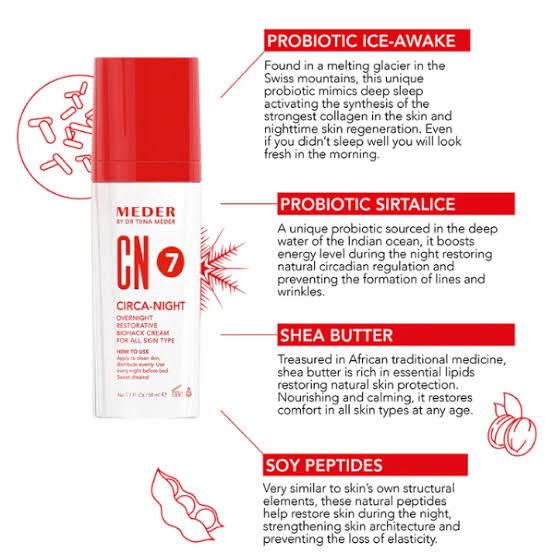
Meder Circa-Night Overnight Repair Cream
Finally - Restorative Night Cream for Tired, Stressed & Sleep-Deprived Skin
Your skin knows what time it is - even when your lifestyle doesn't always cooperate.
Circa-Night is the MEDER cream I reach for when the problem isn't necessarily one particular skin type, but what life is doing to the skin.
Late nights. Interrupted sleep. New baby. Shift work. Travel. Jet lag. Stress. Long working hours. Or simply those periods when you wake up, look in the mirror and your face seems to be announcing exactly how little rest you've had.
This is what makes Circa-Night different from the other MEDER creams.
Arma-Derm is chosen because you're dry. Equa-Derm because you're oily. Salva-Derm because you're sensitive. Lumino-Derm because pigmentation is the concern.
Circa-Night is chosen because we want to support what the skin is supposed to be doing overnight.
It combines biotechnology, probiotic-derived actives, peptides, nourishing lipids and soothing ingredients to support the skin's natural nighttime recovery processes and help reduce the visible effects of stress and insufficient sleep.
I think of it as:
reset β restore β replenish β strengthen β wake up looking fresher.
WHY I LIKE CIRCA-NIGHT
I like this product because it addresses something skincare often ignores:
your skin doesn't function exactly the same way throughout the entire day.
Human biology follows approximately 24-hour patterns called circadian rhythms.
During the day, the skin's priorities are heavily focused on protection from the outside world β UV, pollution, temperature changes, oxidative stress and environmental exposure.
At night, the balance shifts. Processes connected with renewal, barrier recovery and cellular maintenance become particularly important.
That doesn't mean your skin suddenly switches into magical "repair mode" at midnight.
And it definitely doesn't mean it "detoxes" while you sleep.
But timing is part of skin biology.
Circa-Night was developed specifically around that idea.
Rather than simply being a richer moisturiser that happens to have the word night on the jar, its hero ingredients were selected to support processes associated with circadian regulation, cellular energy and overnight recovery.
WHO IS CIRCA-NIGHT FOR?
I particularly like Circa-Night for:
Sleep-deprived skin
When poor or interrupted sleep is showing on your face.
Tired-looking skin
When the complexion appears dull, flat or generally less fresh in the morning.
Stressed skin
Particularly during periods of sustained psychological or physical stress.
New parents
When eight uninterrupted hours of sleep currently sounds like science fiction.
Shift workers
When your work schedule doesn't follow the traditional day-night rhythm.
Frequent travellers
Especially when time-zone changes and disrupted routines affect how the skin looks and feels.
Busy professionals
When late nights, early mornings and irregular schedules become normal.
Mature skin
When recovery processes are becoming less efficient and signs of fatigue are more noticeable.
Skin showing early signs of ageing
When you want to support resilience before lines and loss of elasticity become more established.
Sensitive skin
When you want overnight restorative care without relying on aggressive resurfacing ingredients.
And importantly, Circa-Night is designed for all skin types.
This isn't a dry-skin night cream.
It's an overnight recovery cream.
WHAT ARE CIRCADIAN RHYTHMS?
Your body contains biological timing systems that help coordinate different processes over roughly 24 hours.
Sleep and wakefulness are the most obvious examples, but circadian regulation reaches far beyond sleep.
Hormone release, body temperature, metabolism and many cellular processes follow daily rhythms.
Your skin does too.
Skin cells contain molecular "clocks" that help coordinate when particular biological processes become more or less active.
So your skin at 2 p.m. isn't operating in exactly the same biological environment as your skin at 2 a.m.
This is the science behind the concept of circadian skincare.
We're trying to work with the skin's biological timing rather than pretending time of day is irrelevant.
DOES THE SKIN REALLY REPAIR ITSELF AT NIGHT?
Yes β but I want to phrase this carefully.
Your skin is constantly maintaining and repairing itself. It doesn't wait until bedtime before doing anything useful.
But certain regenerative and barrier-related processes follow circadian patterns and can become more active during the normal rest phase.
That's one reason healthy sleep matters for skin.
The nighttime period gives the body an opportunity to shift resources away from constant daytime environmental defence and towards maintenance and recovery.
So when we talk about overnight repair, we're not talking about a magical switch.
We're talking about supporting biological processes that naturally fluctuate according to time of day.
DOES SKIN βDETOXβ WHILE YOU SLEEP?
Not in the way social media often describes it.
Your liver and kidneys are the major organs responsible for processing and eliminating substances from your body.
Your face doesn't spend the night pushing mysterious "toxins" through your pores.
So Circa-Night isn't a detox cream.
What the skin does need overnight is support for normal cellular maintenance, barrier function, hydration and protection against accumulated stress.
That's a much more scientifically useful way to describe nighttime skincare.
And frankly, it's interesting enough without inventing toxins.
WHAT DOES LACK OF SLEEP ACTUALLY DO TO THE SKIN?
One bad night doesn't suddenly age your face ten years.
But poor sleep can absolutely influence how the skin looks.
After inadequate rest, you may notice:
dullness
puffiness
less even-looking tone
more obvious fine lines
dehydrated appearance
tired-looking eyes
and generally less fresh-looking skin.
Chronic sleep deficiency is more important because sleep influences hormonal regulation, stress signalling, immune function and tissue recovery.
When poor sleep becomes the norm rather than the exception, the skin is repeatedly being asked to function under less-than-ideal conditions.
Circa-Night was developed specifically with this type of lifestyle-related skin stress in mind.
CAN CIRCA-NIGHT REPLACE SLEEP?
No.
And this is probably the most important thing I want to clarify about the product.
MEDER describes Circa-Night as helping mimic some of the visible restorative effects associated with healthy sleep.
I would never translate that as:
βThis cream gives your body eight hours of sleep.β
It doesn't.
No skincare product can replace actual sleep.
Your brain, immune system, cardiovascular system, hormones and the rest of your body still need proper rest.
What Circa-Night can do is support skin processes affected by circadian rhythm and help reduce some of the visible signs associated with tired, stressed skin.
Think:
I didn't sleep brilliantly, but my skin doesn't necessarily need to advertise it.
That's a much more realistic way to understand the product.
WHAT DOES CIRCA-NIGHT ACTUALLY DO?
Circa-Night approaches overnight recovery from several directions.
Ice-Awakeβ’ is a biotechnology-derived active designed to support tired, sleep-deprived skin and processes associated with cellular energy and collagen.
Sirtaliceβ’ supports cellular energy and pathways associated with circadian regulation and skin resilience.
Soy-derived peptides help support the skin's structural proteins and elasticity.
Shea Butter provides nourishing lipids and helps maintain the skin's protective barrier.
Panthenol hydrates, calms and supports skin comfort.
So we're addressing:
circadian support
cellular energy
skin structure
hydration
barrier comfort
and visible fatigue.
That's why Circa-Night isn't simply "a moisturiser you happen to use at night."
Its purpose is much more specific.
WHAT DOES βBIOHACKING SKINCAREβ MEAN?
MEDER describes Circa-Night as a biohacking night cream.
That can sound much more futuristic than it really needs to.
Biohacking, in this context, means using knowledge from biology and biotechnology to influence or support particular biological processes.
We're not hacking your DNA.
We're not reprogramming your body.
We're using ingredients selected to interact with pathways connected with cellular energy, circadian regulation, collagen support and skin recovery.
So whenever you see:
BIOHACKING
on the product information, I want you to translate it as:
βusing modern biotechnology to work with the skin's own biological processes.β
Much less dramatic.
Much easier to understand.
WHY IS CIRCA-NIGHT DIFFERENT FROM A NORMAL NIGHT CREAM?
Traditionally, a night cream was often simply:
your daytime moisturiser β but richer.
The assumption was that because you're going to bed, you can tolerate something heavier and more occlusive.
Circa-Night is different.
Its identity isn't based primarily on richness.
It's based on timing.
The formula was designed around the biological changes associated with the nighttime period and the visible effects of insufficient sleep.
So I don't choose Circa-Night because I think:
"You need something thick at night."
I choose it because:
"I want to support overnight recovery."
That's an important distinction.
HOW TO USE CIRCA-NIGHT
Circa-Night is your final moisturising step in the evening.
Use it once daily before bed.
A typical MEDER evening routine may look like:
Cleanser β everyday serum β targeted Active Care β Circa-Night
STEP 1 β CLEANSE
Use Energy-Net or Net-Apax according to your skin.
If you're wearing substantial makeup or sunscreen, remove it properly before continuing with your skincare.
STEP 2 β APPLY YOUR EVERYDAY SERUM
Use Energy-Soin or Soin-Apax according to your skin's needs.
STEP 3 β APPLY YOUR TARGETED ACTIVE CARE
This might be Hydra-Fill, Red-Apax, Eu-Seb, Arma-Lift, Vita-Long or another product depending on the programme we've created for you.
STEP 4 β APPLY CIRCA-NIGHT
Apply Circa-Night evenly over the face and neck as your final moisturising step.
You don't need another face cream on top.
Then leave your skin alone and go to bed.
Your skincare has finished its shift.
WHEN SHOULD I APPLY IT?
MEDER recommends using Circa-Night once daily before bed.
The important point is consistency rather than obsessing over one exact minute on the clock.
If your bedtime is relatively normal, simply make Circa-Night the final step of your evening skincare routine.
And if your lifestyle is irregular β night shifts, travel, new baby, changing schedules β this is exactly the type of person Circa-Night was designed with in mind.
DO I NEED TO APPLY IT AT EXACTLY THE SAME TIME EVERY NIGHT?
No.
Please don't turn your skincare routine into another source of stress.
Circadian biology is real, but that doesn't mean Circa-Night becomes useless because you applied it at 10:42 instead of 10:15.
Use it consistently as part of your pre-sleep routine.
That's enough.
The goal is to support your skin, not make you anxious about your moisturiser's appointment schedule.
WHAT IF I WORK NIGHT SHIFTS?
This is where Circa-Night becomes particularly interesting.
Shift work can disrupt the normal relationship between environmental light, sleep and the body's internal clock.
MEDER specifically developed Circa-Night with people experiencing disrupted sleep patterns in mind, including shift workers.
If your main sleep period happens during the day, I would generally think of Circa-Night as your pre-sleep restorative cream, rather than becoming obsessed with whether the clock technically says βnight.β
Your biological rest period matters more than the name on the jar.
WHAT IF I HAVE A NEW BABY AND THERE IS NO REAL βBEDTIMEβ?
Welcome to exactly the type of situation this cream was designed for.
Circa-Night was originally conceived partly with new parents and other chronically sleep-deprived people in mind.
Use it during your evening routine or before your main sleep period whenever that is reasonably practical.
And please remember:
the cream isn't there to make you feel guilty about not sleeping enough.
Sometimes sleep disruption isn't a lifestyle choice.
It's simply life.
We're supporting the skin within the reality you're currently living in.
WHAT'S INSIDE IT?
Circa-Night has a surprisingly focused ingredient list.
Rather than throwing dozens of fashionable actives into one cream, its identity is built around a few specific biotechnology-derived ingredients plus supportive moisturising and barrier ingredients.
ICE-AWAKEβ’
Ice-Awakeβ’ is one of Circa-Night's signature ingredients.
It's derived through biotechnology involving a microorganism originally identified in a Swiss glacial environment.
MEDER uses it specifically for sleep-deprived and tired-looking skin.
The ingredient is designed to support cellular energy and biological processes associated with collagen production and recovery, helping skin look fresher and more resilient even when sleep hasn't been ideal.
The glacier story is interesting.
But the glacier isn't the important part.
The important part is what the biotechnology is being used to achieve:
help tired skin behave less like tired skin.
That's what matters to us.
DOES ICE-AWAKEβ’ CONTAIN LIVE BACTERIA?
This is worth clarifying because MEDER often uses the word probiotic.
In cosmetic skincare, βprobioticβ doesn't necessarily mean you're applying colonies of live microorganisms to your face.
Biotechnology can use microorganisms, ferments or microorganism-derived components to create useful cosmetic actives.
So don't imagine tiny glacier bacteria setting up home in your moisturiser.
What we're interested in is the bioactive material created through that biotechnology and how it interacts with skin.
SIRTALICEβ’
Sirtaliceβ’ is another biotechnology-derived ingredient and one of the most interesting components of Circa-Night.
MEDER uses it to support cellular energy, skin resilience and circadian regulation.
Why does cellular energy matter?
Because every biological process requires energy.
Skin cells need energy to maintain themselves, communicate, synthesise structural components and carry out normal repair processes.
When we're dealing with stressed or sleep-deprived skin, supporting those normal cellular functions becomes particularly relevant.
I think of Sirtaliceβ’ as the:
βhelp the night shift actually do its jobβ
part of the formula.
WHAT ARE SIRTUINS?
The name Sirtaliceβ’ relates to an interesting area of longevity biology involving proteins called sirtuins.
Sirtuins participate in cellular processes connected with metabolism, stress responses and ageing.
They are sometimes dramatically described as βlongevity genes,β but that's an oversimplification.
What matters for us is that pathways involving cellular energy and stress adaptation are relevant to how tissues maintain themselves over time.
Circa-Night uses biotechnology designed to support this broader area of cellular resilience and overnight function.
You don't need to memorise the word sirtuin.
Just remember:
better-supported cellular function = better conditions for healthy skin recovery.
SOY-DERIVED PEPTIDES
Peptides are small chains of amino acids.
And amino acids are the building blocks used to make proteins.
The soy-derived peptide component in Circa-Night is used to support the skin's structural architecture and processes connected with collagen and elasticity.
This becomes particularly useful as skin matures because structural proteins gradually change with age.
The purpose isn't to claim that a peptide cream can rebuild your entire face overnight.
It's to provide biological signals and supportive ingredients that encourage healthier skin function over time.
That's the realistic role of good peptide skincare.
WILL CIRCA-NIGHT BUILD COLLAGEN?
Its hero ingredients are designed to support pathways associated with collagen synthesis and skin structure.
But I don't want to translate that into:
βApply this tonight and wake up with brand-new collagen tomorrow.β
Collagen remodelling is gradual.
What you may notice first is improved:
hydration.
smoothness.
freshness.
comfort.
and less tired-looking skin.
Changes connected with structural support require consistent use over time.
Skincare works biologically.
Not magically.
SHEA BUTTER
Shea Butter provides the nourishing side of Circa-Night.
It's rich in lipids that help soften the skin, support barrier comfort and reduce excessive moisture loss.
And I like its inclusion here because nighttime recovery isn't only about sophisticated biotechnology.
Sometimes the skin simply needs:
water + lipids + protection.
You can have the most advanced peptide in the world, but if the skin barrier is uncomfortable and dehydrated, we're still missing something fundamental.
Shea Butter gives Circa-Night that nourishing foundation without turning the entire concept into nothing more than a rich night cream.
PANTHENOL
Panthenol β pro-vitamin B5 β supports hydration and helps calm the skin.
It's particularly useful when stress, environmental exposure or lack of sleep has left the skin feeling less comfortable than usual.
Panthenol isn't the glamorous part of the formula.
But that's exactly why I like ingredients like this.
While the biotechnology ingredients are doing the sophisticated signalling work, panthenol quietly helps maintain:
hydration
softness
comfort
and barrier support.
A good formula needs both.
WHY CAN MY FACE LOOK PUFFY AFTER A BAD NIGHT?
Morning puffiness can be influenced by several things, including fluid distribution, sleeping position, alcohol, salt intake, hormonal changes and poor-quality sleep.
When you lie horizontally for hours, fluid distribution around the face and eye area also changes.
That's why somebody can wake up looking noticeably puffier even though nothing is actually βwrongβ with their skin.
MEDER positions Circa-Night as helping reduce the visible morning signs associated with sleep deficiency, including puffiness and tired-looking skin.
But if facial swelling is persistent, severe or unusual for you, that's not something I would simply treat with skincare.
WHY DOES MY SKIN LOOK DULL AFTER POOR SLEEP?
Because βglowβ isn't one biological process.
It depends on several things working together:
hydration.
surface smoothness.
circulation.
skin tone.
barrier condition.
and how evenly light reflects from the surface.
When you're tired, dehydrated or stressed, several of these can change at once.
The result is the classic:
"I look exhausted."
Circa-Night supports hydration, skin structure and overnight recovery so that the complexion can look fresher and more rested in the morning.
Not artificially shiny.
Not glittery.
Just healthier-looking.
CIRCA-NIGHT OR MY NORMAL MEDER CREAM?
You don't necessarily need to choose one forever.
Think of your daytime cream as being selected primarily according to skin type or specific concern.
Then think of Circa-Night according to time and recovery.
For example:
Dry skin
Arma-Derm morning β Circa-Night evening
Oily skin
Equa-Derm morning β Circa-Night evening, if the texture suits your skin
Sensitive skin
Salva-Derm morning β Circa-Night evening
Pigmentation
Lumino-Derm may remain your dedicated pigmentation cream according to your programme, so we would decide individually whether and how Circa-Night fits around it.
Normal/dehydrated skin
Derma-Fill morning β Circa-Night evening
Circa-Night doesn't make the other creams obsolete.
It gives us a dedicated nighttime option.
CIRCA-NIGHT OR ARMA-DERM?
This is particularly relevant because both can feel nourishing.
ARMA-DERM
Choose it primarily for:
dryness
lipid deficiency
flaking
barrier support
and mature skin that needs richer everyday moisturisation.
Think:
DRY SKIN CARE.
CIRCA-NIGHT
Choose it primarily for:
overnight recovery
sleep deprivation
stress-related fatigue
circadian support
and prevention of premature age-related changes.
Think:
NIGHT RECOVERY.
And yes, MEDER specifically supports using:
Arma-Derm in the morning β Circa-Night at night.
That's an excellent combination for dry, mature or stressed skin.
CIRCA-NIGHT OR VITA-LONG 2.0?
These are complementary rather than interchangeable.
VITA-LONG 2.0
Vita-Long is targeted skin longevity Active Care.
Its focus is broader age-management and supporting biological pathways associated with long-term skin resilience.
It goes before your cream.
CIRCA-NIGHT
Circa-Night is your night moisturiser.
Its focus is circadian support, overnight recovery and reducing visible signs associated with stress and poor sleep.
So when appropriate:
Vita-Long 2.0 β Circa-Night
can make complete sense.
Think:
Vita-Long = longevity strategy
Circa-Night = nighttime recovery environment.
CIRCA-NIGHT OR ARMA-LIFT?
Again, different jobs.
ARMA-LIFT
Targets mature skin, firmness, elasticity and structural age-related changes.
CIRCA-NIGHT
Targets overnight recovery, fatigue and circadian skin function.
For mature skin, the combination can be very logical:
Arma-Lift β Circa-Night
at night.
Arma-Lift provides the targeted age-well treatment.
Circa-Night completes the routine with overnight moisturising and restorative support.
DO I STILL NEED AN ACTIVE SERUM UNDER CIRCA-NIGHT?
Only if your skin actually needs one.
Circa-Night doesn't automatically replace targeted Active Care.
If we're treating dehydration, pigmentation, redness, acne, mimic wrinkles or mature skin changes, your targeted product may still sit underneath it.
But if your skin is doing beautifully and your main concern is simply fatigue and overnight support?
You don't need to add a serum just to make the routine look more impressive.
A perfectly respectable evening routine can be:
Cleanse β everyday serum β Circa-Night.
Skincare doesn't earn extra points for complexity.
CAN SENSITIVE SKIN USE CIRCA-NIGHT?
MEDER positions Circa-Night for all skin types, including sensitive skin.
The formula doesn't rely on aggressive exfoliation or retinoids to create its overnight effect.
That's important because "night repair" is sometimes interpreted as:
strong acids + retinoid + peeling = regeneration.
Not necessarily.
Skin can be supported overnight without deliberately irritating it.
For very reactive skin, I would still introduce any new product thoughtfully and keep the rest of the routine calm.
Sensitive skin doesn't need five new things arriving on the same evening.
CAN OILY SKIN USE CIRCA-NIGHT?
Yes, MEDER describes it as suitable for all skin types.
But texture preference still matters.
If you have very oily skin and Equa-Derm keeps you beautifully balanced, you don't have to replace it at night simply because Circa-Night exists.
Circa-Night becomes particularly interesting when stress, sleep deprivation and fatigue are significant concerns.
If excessive sebum or acne remains the priority, your oily-skin programme still comes first.
Remember:
use products because they solve a problem you have.
Not because they're available.
CAN I USE CIRCA-NIGHT DURING PREGNANCY?
MEDER states that Circa-Night is suitable during pregnancy and breastfeeding.
In fact, the brand specifically highlights new parenthood as one of the situations where the product can be particularly useful because interrupted sleep is so common.
And I like the logic here.
Pregnancy and early parenthood are not necessarily the time when somebody wants an extremely complicated aggressive anti-ageing programme.
Sometimes what the skin needs is:
hydration, comfort, recovery and support.
DOES CIRCA-NIGHT CONTAIN RETINOL?
No.
The current formula does not rely on retinol for its restorative or age-supportive effects.
That's one of the things that makes Circa-Night interesting for clients who want an overnight age-supportive product but don't want to use a retinoid.
That doesn't mean retinoids are bad.
They're extremely useful when appropriate.
Circa-Night simply takes a different route through biotechnology, peptides, circadian support and barrier care.
CAN I USE CIRCA-NIGHT EVERY NIGHT?
Yes.
Circa-Night is designed for daily evening use.
You don't need to cycle it.
You don't need three nights on and two nights off.
And you don't need to wait until you've slept badly before you're βallowedβ to use it.
Think of it as your regular night moisturiser, particularly when stress, ageing or irregular sleep are relevant concerns.
DO I NEED IT IF I SLEEP WELL?
You can still use it.
Circa-Night isn't only emergency skincare for the morning after a terrible night.
Its ingredients also support hydration, skin structure and normal nighttime recovery.
But if you sleep beautifully, your skin is healthy, you love your existing moisturiser and there is no particular nighttime concern?
Then Circa-Night isn't something I would tell you that you must buy.
Good skincare isn't about collecting every product in the range.
It's about choosing the ones that make sense for your skin and your life.
WHAT IF I'M HAVING A PARTICULARLY BAD WEEK OF SLEEP?
This is exactly when I'd make sure you're being consistent with Circa-Night.
But I'd also look at the rest of the routine.
Poor sleep is not the time to compensate by doing:
strong peel.
retinol.
scrub.
three new serums.
and an aggressive facial.
Your body is already under stress.
Keep the skincare supportive.
Cleanse properly. Hydrate. Use the targeted products you already tolerate. Apply Circa-Night. Protect the skin during the day.
Don't turn a stressful week into a stressful skincare routine as well.
WHAT SHOULD I EXPECT IN THE MORNING?
The immediate goal is that skin looks and feels:
fresher
better hydrated
smoother
less tired
more comfortable
and generally more rested.
With consistent use, the formula is also designed to support resilience, elasticity and the prevention of premature signs of ageing associated with stress and insufficient sleep.
But I don't want you inspecting your face every morning looking for a new collagen fibre.
Look at the overall pattern.
Does your skin recover better? Does it look less dull after poor sleep? Is morning dehydration reduced? Does it look smoother and fresher?
Those are much more useful measures.
WHEN WILL I SEE A DIFFERENCE?
Some of the hydration, softness and morning-freshness benefits may be noticeable relatively quickly.
The more structural benefits require consistent use.
Peptides and biotechnology don't change the architecture of your skin overnight.
So think in two timelines:
SHORT TERM:
hydration, comfort, smoother appearance, fresher-looking morning skin.
LONGER TERM:
support for elasticity, resilience, collagen-related processes and prevention of stress-related premature ageing.
Both matter.
They're simply not the same thing.
MY CIRCA-NIGHT RULES
If you remember nothing else from this page, remember these:
Your skin has a biological clock.
Skin function changes according to circadian rhythms, and nighttime is an important period for maintenance and recovery.
Circa-Night cannot replace actual sleep.
It can help the skin cope with visible signs of sleep deficiency. Your body still needs rest.
Nighttime repair doesn't mean βdetox.β
Your skin isn't purging mysterious toxins through your pores while you sleep.
A night cream doesn't simply have to be a heavier day cream.
Circa-Night is formulated specifically around nighttime biology and sleep-related skin stress.
Use it as your final evening moisturiser.
Cleanser β serum β targeted Active Care β Circa-Night.
You don't need every Active Care underneath it.
Treat the concerns you actually have.
Shift workers can use it too.
Think about your main sleep/rest period rather than becoming obsessed with the number on the clock.
Poor sleep isn't a reason to attack your skin.
During stressful periods, supportive skincare often makes more sense than aggressive treatment.
All skin types can use it.
But that doesn't mean every skin type automatically needs it.
Consistency matters more than one miraculous night.
Immediate freshness is lovely. Long-term resilience requires regular care.
THE BOTTOM LINE
Circa-Night is the cream I want you to think of when your skin needs help recovering from the life you're actually living β not the perfectly rested life skincare advertising sometimes pretends we all have.
Maybe you work late.
Maybe you travel.
Maybe you have children.
Maybe you're under pressure.
Maybe your sleep isn't brilliant.
Or maybe you're simply getting older and noticing that one bad night now shows on your face considerably more than it did ten years ago.
Circa-Night doesn't pretend it can replace sleep.
What it does is work with an area of skin biology we now understand much better: circadian regulation and nighttime recovery.
Its biotechnology-derived actives support cellular energy and processes associated with overnight function. Peptides support the skin's structural environment. Shea Butter and Panthenol take care of hydration, lipids and comfort.
The result we're looking for is skin that becomes better at recovering overnight and less likely to display every difficult day the following morning.
And I think that's the best way to understand Circa-Night.
Not:
sleep in a jar.
But:
better support for skin during the hours when recovery should be taking centre stage.
Because sometimes we can't immediately change the stressful week, the crying baby, the flight schedule or the 6 a.m. alarm.
But we can at least make sure our skincare isn't making the situation harder.
CIRCA-NIGHT AT A GLANCE
What is it?
A restorative night moisturiser designed to support circadian skin function, overnight recovery and skin affected by stress or insufficient sleep.
Best for:
Tired-looking skin, sleep deprivation, stress-related skin changes, dullness, visible fatigue, early signs of ageing and anyone wanting dedicated overnight recovery care.
Recommended age:
25+
Skin type:
All skin types, including sensitive skin.
How often?
Once daily, before bed.
Where does it go in my routine?
As your final moisturising step after your everyday serum and any targeted Active Care.
Do I need another moisturiser over it?
No. Circa-Night is your night cream.
Can it replace sleep?
No. It supports the skin and helps reduce visible signs associated with insufficient sleep, but it does not replace the biological benefits of actual sleep.
Can I use it if I work night shifts?
Yes. Circa-Night is particularly relevant to people with disrupted sleep schedules. Think of it as your restorative pre-sleep moisturiser.
Can oily skin use it?
Yes. MEDER positions it for all skin types, although very oily skin should still prioritise appropriate sebum and acne management where necessary.
Can sensitive skin use it?
Yes.
Does it contain retinol?
No.
Can I use it during pregnancy and breastfeeding?
MEDER states that Circa-Night is suitable during pregnancy and breastfeeding.
Can I use it with Arma-Derm?
Yes. A particularly useful routine for dry skin is Arma-Derm during the day and Circa-Night at night.
Can I use it with Vita-Long 2.0 or Arma-Lift?
Yes, when appropriate. Your targeted Active Care goes underneath Circa-Night.
Hero ingredients:
Ice-Awakeβ’, Sirtaliceβ’, soy-derived peptides, Shea Butter and Panthenol.
What comes before it?
Cleanser β everyday serum β targeted Active Care if required.
What comes after it?
Nothing. Go to bed.
Size:
50 ml