Skip to product information
1 of 5

Meder Eu-Skin Prebiotic Anti-Acne Cream for Face & Body

Meder Eu-Skin Prebiotic Anti-Acne Cream for Face & Body

Order by request

Acne needs treatment. Your skin doesn't need punishment.

Eu-Skin is the MEDER cream I reach for when the problem has moved beyond simply having oily skin and we're dealing with actual acne: active breakouts, inflammatory spots, blackheads, whiteheads, recurring hormonal blemishes or persistent congestion.

And this distinction matters.

Not everybody with oily skin has acne, and not everybody with acne has extremely oily skin.

For years, acne skincare was largely built around one idea: dry the skin, remove the oil and destroy the bacteria.

The result was often skin that was certainly less oily - but also red, flaky, uncomfortable, dehydrated and increasingly difficult to manage.

Eu-Skin takes a very different approach. Instead of trying to strip the skin into submission, it works with the microbiome, inflammation, comedone formation and post-acne pigmentation, while keeping the skin hydrated and comfortable.

I think of it as:

control β†’ calm β†’ rebalance β†’ clear β†’ recover.


WHY I LIKE EU-SKIN

Acne is inflammatory.

So I don't see much sense in treating inflammation by creating more inflammation.

Of course there are situations where strong medical acne treatments are absolutely appropriate, and skincare should never pretend otherwise. But for everyday cosmetic management, I like that Eu-Skin gives us a gentler strategy.

It contains no retinol or exfoliating acids and isn't designed to make your skin peel before you see improvement.

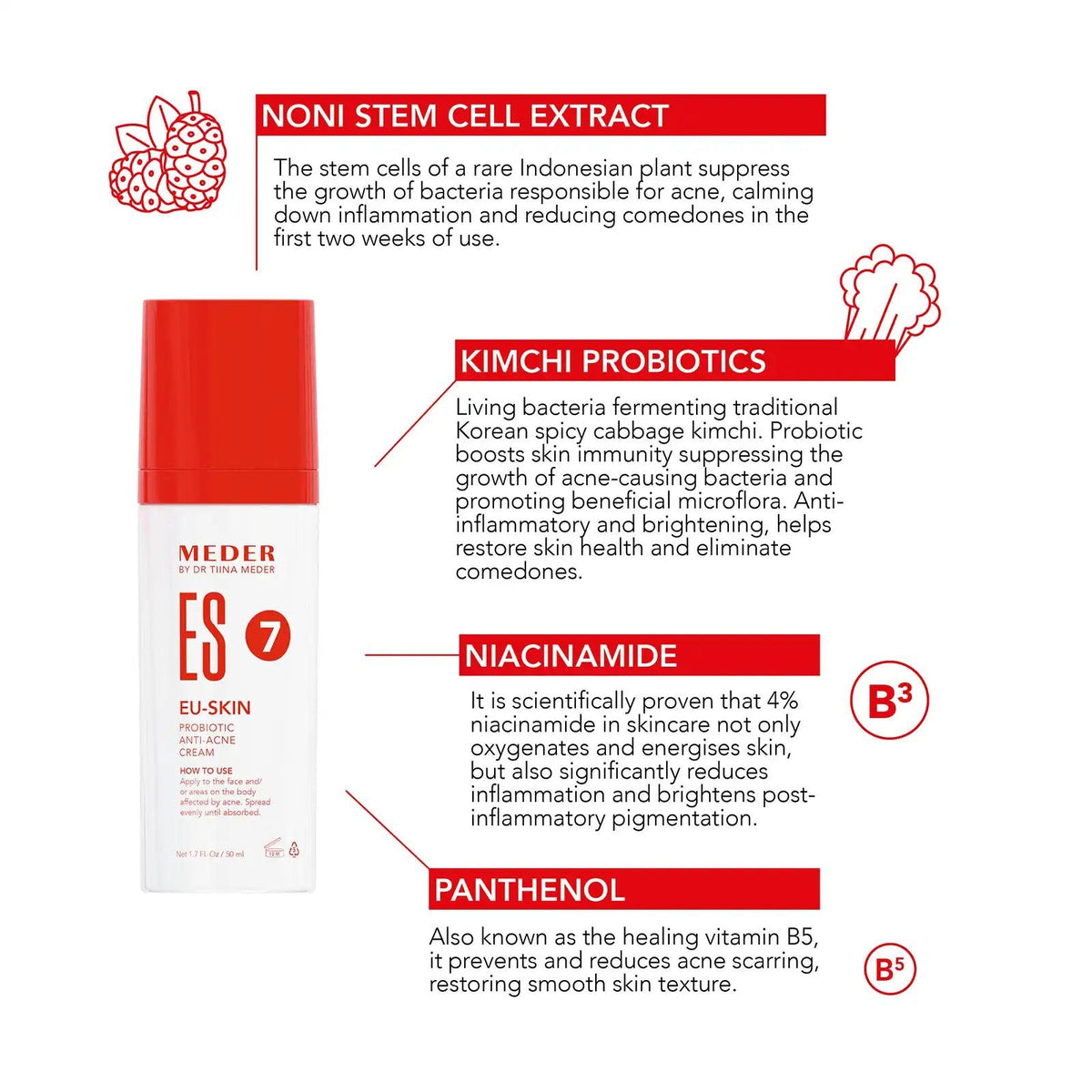
Instead, MEDER has built the formula around Noni plant-cell technology, fermented ingredients, 4% niacinamide and panthenol.

That means we're addressing the acne while simultaneously thinking about what happens to the skin during and after the breakout.

Redness matters.

Dehydration matters.

The microbiome matters.

Post-inflammatory marks matter.

The health of the skin surrounding the spot matters too.

We're not treating a collection of pimples. We're treating skin that happens to have acne.


WHO IS EU-SKIN FOR?

I particularly like Eu-Skin for:

Active acne
When inflammatory blemishes are already present and need targeted care.

Adult acne
Especially recurring breakouts that continue well beyond the teenage years.

Hormonal acne
When blemishes tend to follow hormonal fluctuations and repeatedly appear around areas such as the chin and jawline.

Teenage acne
When comedones, oiliness and inflammatory breakouts begin appearing during puberty.

Period-related breakouts
When the skin predictably becomes more congested or inflamed around the menstrual cycle.

Stress-related acne
When periods of stress consistently seem to coincide with worsening breakouts.

Chronic or recurring acne
When spots disappear only to be replaced by another group shortly afterwards.

Comedonal acne
When blackheads and whiteheads are a major part of the problem.

Sensitive acne-prone skin
Particularly when traditional acid- or retinoid-heavy acne routines have been difficult to tolerate.

Body acne
Including breakouts on areas such as the back, chest, shoulders or buttocks.

That last point is important.

Eu-Skin isn't restricted to the face.

If acne is appearing elsewhere on the body, the cream can be applied directly to those affected areas too.


FIRST β€” ACNE IS NOT CAUSED BY DIRTY SKIN

Please remember this.

Having acne does not mean your face is dirty.

And washing it five times a day isn't going to make you cleaner than somebody without acne.

Acne develops through an interaction between several factors, including:

sebum production

follicular blockage

microorganisms

inflammation

hormonal influences

and individual genetic susceptibility.

So when somebody develops acne, the answer isn't:

"You need to wash your face better."

In fact, excessive cleansing can leave acne-prone skin more irritated, dehydrated and uncomfortable.

Clean skin matters.

Over-cleaned skin doesn't help.


WHAT ACTUALLY HAPPENS WHEN A SPOT FORMS?

A spot usually begins long before you can see it.

Inside a hair follicle, skin cells and sebum can begin accumulating instead of moving normally out of the pore.

This creates a blockage.

If the follicle remains closed, we may see a whitehead.

If the opening remains exposed to air, the material oxidises and we see a blackhead.

If inflammation develops around the follicle, the lesion can become red, swollen and painful.

That's why acne treatment needs to think beyond simply drying the spot sitting on the surface.

We need to consider the environment inside and around the follicle.


BLACKHEADS ARE NOT DIRT

This deserves its own section because so many people still believe it.

A blackhead isn't black because your pore is full of dirt.

It's an open comedone.

Material inside the follicle is exposed to oxygen at the surface and undergoes oxidation, creating the characteristic darker colour.

Scrubbing harder isn't going to solve the biological reason it formed.

And squeezing every blackhead you can see may create inflammation, trauma and pigmentation.

Treat the reason the pore is becoming congested.

Don't punish the pore for existing.


AND WHITEHEADS?

A whitehead is a closed comedone.

The follicle becomes blocked, but unlike a blackhead, the opening remains covered by a thin layer of skin.

Again, this isn't simply a cleanliness problem.

Comedone formation involves the behaviour of skin cells within the follicle, sebum and the surrounding inflammatory environment.

One of the reasons 4% niacinamide is particularly interesting in Eu-Skin is that MEDER uses it not only for inflammation and pigmentation but also as part of its strategy for reducing comedone formation.


ACNE IS NOT JUST ABOUT OIL

Excessive sebum can absolutely contribute to acne.

But if oil were the whole story, everybody with oily skin would have acne.

They don't.

And everybody with acne would have extremely oily skin.

They don't either.

Acne involves a much more complicated relationship between the follicle, sebum, inflammation, microorganisms, hormones and immune response.

This is why MEDER separates:

Equa-Derm β€” primarily for excessive oil

from

Eu-Skin β€” specifically for acne.

The two concerns overlap.

But they aren't identical.


THE MICROBIOME CHANGES THE WAY WE THINK ABOUT ACNE

This is one of the most interesting parts of Eu-Skin.

Your skin is covered in microorganisms.

And that's normal.

Healthy skin is not sterile.

One of the bacteria commonly associated with acne is Cutibacterium acnes, often shortened to C. acnes.

For a long time, acne treatment was described very simply:

C. acnes = bad bacteria β†’ kill the bacteria β†’ cure acne.

We now know the picture is considerably more complicated.

C. acnes is also found on healthy skin. Different microbial populations, strains and interactions can behave differently, and the overall balance of the skin ecosystem matters.

So our goal shouldn't automatically be:

destroy everything living on the face.

We want a healthier microbial environment in which acne-associated inflammation is less likely to dominate.

That is the philosophy behind Eu-Skin.


WHAT IS A BIOFILM?

You'll see MEDER talk quite a lot about biofilms in relation to acne.

A biofilm is essentially an organised community of microorganisms embedded within a protective matrix.

Instead of individual bacteria simply floating around independently, they can organise into communities that communicate and become more resistant to environmental challenges.

Think of the difference between:

one person standing alone

and

an organised city with walls, roads and communication systems.

That's an oversimplification, but it helps explain the idea.

MEDER's acne philosophy is partly based on influencing this microbial communication and preventing the kind of organised overgrowth associated with persistent inflammatory conditions.

This is where the Noni-derived technology in Eu-Skin becomes particularly interesting.


WHAT DOES EU-SKIN ACTUALLY DO?

Eu-Skin approaches acne from several directions at the same time.

Noni Stem Cell Extract is used to influence the acne-associated microbial environment and help reduce inflammation and comedones.

4% Niacinamide helps calm inflammation, support barrier function, reduce comedone formation and gradually brighten post-inflammatory pigmentation.

Fermented probiotic-derived ingredients support a healthier microbial environment rather than relying solely on aggressive antibacterial action.

Panthenol hydrates and soothes the skin, helping maintain comfort while acne is being treated.

So instead of:

spot β†’ dry it out

we have:

address the microbial environment β†’ calm inflammation β†’ reduce congestion β†’ support recovery β†’ improve the marks acne leaves behind.

That's a much more complete way of thinking about acne care.


WHAT'S INSIDE IT?

Eu-Skin's hero formula is deliberately focused.

We don't need twenty aggressive actives fighting for attention.

We need ingredients that work together.

NONI STEM CELL EXTRACT

Noni β€” Morinda citrifolia β€” is a tropical plant traditionally used in parts of Southeast Asia and the Pacific.

MEDER uses a Noni callus culture lysate in Eu-Skin as part of its microbiome-focused approach to acne.

The interesting part isn't simply that Noni is a plant.

Plenty of plants sound exotic.

What matters is the idea behind its use: compounds associated with the plant can influence microbial behaviour and help disrupt the environment in which acne-associated bacterial communities thrive.

Think:

not scorched earth.

More like:

interrupt the bad neighbourhood meeting.

We're trying to stop acne-associated microorganisms from organising themselves into an inflammatory environment without unnecessarily destroying the entire skin ecosystem.


DOES EU-SKIN KILL ACNE BACTERIA?

MEDER reports very strong in-vitro results for Eu-Skin against acne-associated bacteria.

But I want to explain what that means properly.

In vitro means the testing was performed under laboratory conditions β€” not that every person applying Eu-Skin to their face will experience exactly the same numerical bacterial reduction.

Laboratory results help us understand what a formula can do biologically.

Real human skin is considerably more complicated.

So I would rather tell you:

Eu-Skin has demonstrated strong activity against acne-associated microorganisms in laboratory testing

than promise:

β€œIt kills exactly X% of your acne bacteria.”

That is a much more responsible way to interpret the data.


NIACINAMIDE 4%

Niacinamide is vitamin B3, and it's one of the most useful multifunctional ingredients in acne-prone skincare.

At 4%, Eu-Skin uses it for several reasons.

It helps calm inflammatory processes associated with breakouts.

It supports healthy barrier function.

It can help regulate aspects of sebum and follicular behaviour.

And importantly, it helps improve post-inflammatory pigmentation β€” those brown or darker marks that remain after the spot itself has disappeared.

This makes niacinamide particularly useful because acne has two stages:

the breakout

and

what the breakout leaves behind.

We want to think about both.


WILL NIACINAMIDE BLEACH MY SKIN?

No.

Brightening post-acne pigmentation doesn't mean bleaching healthy skin.

The goal is to help excessive pigment left behind after inflammation gradually become less visible, creating a more even-looking complexion.

This is particularly important in deeper skin tones, where post-inflammatory hyperpigmentation can sometimes remain visible considerably longer than the original spot.

We're not trying to make your natural skin colour lighter.

We're trying to reduce the uneven pigment caused by previous inflammation.


WHY DO SPOTS LEAVE DARK MARKS?

When skin becomes inflamed, pigment-producing cells can respond by producing or distributing more melanin.

After the inflammation settles, that excess pigment may remain.

This is called post-inflammatory hyperpigmentation, or PIH.

The frustrating part is that the spot may disappear in a week while the mark remains for weeks or months.

And if you pick or squeeze the spot, you create additional trauma and inflammation, potentially making the pigmentation worse.

So one of my rules for acne is:

treat the spot as though you care about what the skin will look like after the spot is gone.

Eu-Skin's niacinamide helps us do exactly that.


WHAT ABOUT RED MARKS AFTER ACNE?

Not every post-acne mark is pigmentation.

Some people β€” particularly lighter skin tones β€” are left with persistent red or pink marks after a blemish.

This is often referred to as post-inflammatory erythema.

It's related more to vascular and inflammatory changes than excess melanin.

That distinction matters because brown pigmentation and persistent redness don't always respond to exactly the same strategies.

Eu-Skin's calming approach can support the overall recovery process, but persistent post-acne redness may require additional time or targeted treatment.


FERMENTED / PROBIOTIC-DERIVED INGREDIENTS

MEDER uses fermented ingredients in Eu-Skin as part of its microbiome-focused acne strategy.

The idea is not to sterilise the skin.

It's to encourage an environment in which the skin's microbial ecosystem can become more balanced.

This matters because the microbiome interacts with:

inflammation

barrier function

immune signalling

and the behaviour of acne-associated microorganisms.

I want you to think:

ecosystem management

rather than:

disinfect the face.

That's a much better description of modern microbiome-friendly skincare.


PANTHENOL

Panthenol β€” pro-vitamin B5 β€” gives us the recovery side of the formula.

It helps:

hydrate

calm

soften

and support skin comfort.

Why put a soothing moisturising ingredient in an acne treatment?

Because acne-prone skin still needs a healthy barrier.

In fact, maintaining skin comfort can be extremely important for consistency.

If your acne routine leaves your face burning, peeling and painful every day, you're much less likely to keep using it.

Effective skincare only works when you can actually live with it.


DOES PANTHENOL PREVENT ACNE SCARS?

MEDER describes panthenol as helping reduce or prevent acne scarring.

I would phrase this more carefully.

Panthenol supports hydration, soothing and normal skin recovery, all of which create a healthier environment while blemishes heal.

But no cosmetic ingredient can guarantee that inflammatory acne will never scar.

The best scar-prevention strategy is:

control significant acne early

reduce unnecessary inflammation

don't pick

and seek appropriate medical treatment when acne is severe enough to carry a meaningful scarring risk.

Eu-Skin supports that process.

It doesn't make scar formation biologically impossible.


EU-SKIN OR EQUA-DERM?

This is probably the most important comparison.

CHOOSE EQUA-DERM IF...

Your main problem is:

excessive oil

persistent shine

enlarged-looking pores

oily or combination skin

with perhaps occasional breakouts.

Think:

CONTROL THE SEBUM.

CHOOSE EU-SKIN IF...

Your main problem is:

active acne

recurring blemishes

blackheads and whiteheads

inflammatory breakouts

hormonal acne

or persistent acne affecting the face or body.

Think:

TREAT THE ACNE.

You can be oily without needing Eu-Skin.

And you can need Eu-Skin without being dramatically oily.

That's why skin diagnosis matters.


EU-SKIN OR EU-SEB?

These two belong beautifully together, but they aren't duplicates.

EU-SEB

Eu-Seb is your targeted Active Serum.

It goes earlier in the routine and focuses strongly on the acne-prone microbial environment, excessive sebum, inflammation and comedones.

EU-SKIN

Eu-Skin is the anti-acne cream.

It completes the treatment with Noni-derived technology, niacinamide, fermented ingredients and panthenol while providing the moisturising step.

So for active acne, MEDER recommends combining them.

Think:

Eu-Seb = targeted active treatment

Eu-Skin = anti-acne treatment + final cream step

They approach the same problem from complementary angles.


CAN I USE EU-SEB AND EU-SKIN TOGETHER?

Yes.

In fact, that's one of MEDER's recommended combinations for acne-prone skin.

A typical routine may look like:

Net-Apax β†’ Soin-Apax β†’ Eu-Seb β†’ Eu-Skin

The important thing is that we don't then assume:

"If four products are good, fourteen must be better."

Acne-prone skin does not need a bathroom shelf full of competing active ingredients.

Give the programme enough time to work.


HOW TO USE EU-SKIN

Apply Eu-Skin to clean skin on the areas affected by acne, morning and evening.

It can be used on the face or body.

STEP 1 β€” CLEANSE

For acne-prone skin, I still want a gentle cleanser.

Net-Apax can be an excellent choice when sensitivity is present.

The goal is to remove sunscreen, makeup, excess oil and environmental debris without repeatedly stripping the barrier.

STEP 2 β€” APPLY YOUR EVERYDAY SERUM

Use Soin-Apax or the everyday serum appropriate for your skin.

STEP 3 β€” APPLY EU-SEB

If Eu-Seb is part of your programme, apply it before Eu-Skin and allow it to absorb.

STEP 4 β€” APPLY EU-SKIN

Apply Eu-Skin over the acne-affected areas.

This can include the face, chest, back or other body areas where breakouts occur.

STEP 5 β€” SPF DURING THE DAY

Finish your morning routine with an appropriate sunscreen.

Preferably choose a texture that works comfortably with acne-prone skin.


HOW LONG SHOULD I USE IT?

This is not a three-day spot cream.

MEDER recommends using Eu-Skin consistently for at least several weeks, and its current instructions specifically recommend continuing for around 8 weeks or longer, until acne spots and comedones have cleared.

That makes sense.

Acne develops over time.

New comedones can already be forming beneath the surface before you see them.

So don't judge an acne programme exclusively by what happens to the three visible spots you had on day one.

We're looking at the pattern of breakouts over time.

Are fewer new spots appearing?

Is inflammation decreasing?

Are comedones becoming less frequent?

Are old marks clearing?

Is the skin more stable?

That's how I want you to judge progress.


WHY DOES ACNE TREATMENT TAKE TIME?

Because the spot you see today isn't the whole condition.

Acne involves processes happening within follicles over weeks.

When you begin treatment, you may still see blemishes emerge that had already begun developing before you started.

This is why consistency matters so much.

If you change your entire routine every seven days because another spot appeared, you never give any strategy enough time to show you what it can actually do.

Take photographs.

Look at trends.

Judge the month, not Tuesday morning.


CAN I USE EU-SKIN AS A SPOT TREATMENT?

You can apply it to acne-affected areas, but I don't think of Eu-Skin primarily as a tiny dab-on spot treatment.

If you repeatedly break out across a particular zone β€” for example the chin, jawline, forehead, chest or upper back β€” it often makes more sense to treat the acne-prone area, not just the one visible blemish.

Remember:

what you can see today isn't necessarily the only follicle in which acne is developing.

We're trying to improve the environment of the whole affected area.


CAN I USE IT ON BODY ACNE?

Yes.

This is one of Eu-Skin's biggest advantages.

MEDER specifically formulates it for face and body.

You can use it on acne affecting areas such as:

chest

back

shoulders

buttocks

or other acne-prone areas.

For body acne, consistency becomes especially important because people often treat their face religiously while remembering their back twice a month.

The skin doesn't know that one area is less convenient to reach.

Treatment still needs regularity.


WHAT CAUSES BODY ACNE?

Many of the same biological processes involved in facial acne can occur on the body.

But additional factors can contribute:

sweat.

friction.

tight clothing.

sports equipment.

occlusive fabrics.

hair products contacting the back.

and delayed showering after exercise.

So if we're treating body acne, I don't only look at the cream.

I also look at:

what is repeatedly happening to that area every day?

Sometimes changing one practical habit makes the skincare work much better.


WHAT IS β€œATHLETE'S ACNE”?

Exercise itself isn't bad for your skin.

But sweat, heat, friction and occlusion can create an environment that encourages breakouts.

Think:

sports bras.

helmets.

tight synthetic clothing.

backpacks.

protective equipment.

If the same area is repeatedly warm, sweaty and rubbed, acne or acne-like eruptions may become more likely.

So use your Eu-Skin β€” but also remove sweaty clothing promptly, shower appropriately and clean equipment that repeatedly touches the skin.

Skincare works best when we stop recreating the problem every afternoon.


WHAT ABOUT HORMONAL ACNE?

Hormones can strongly influence sebaceous activity and acne development.

That's why some people notice predictable breakouts:

around menstruation.

during puberty.

during pregnancy.

after stopping hormonal contraception.

during perimenopause.

or alongside certain hormonal conditions.

Eu-Skin can help manage the skin expression of hormonal acne.

But it doesn't alter the underlying hormonal cause.

If acne is sudden, severe, persistent or accompanied by other hormonal symptoms, skincare shouldn't be used as a substitute for appropriate medical assessment.

We can treat the skin.

Sometimes we also need to investigate why the skin is behaving this way.


WHAT ABOUT ADULT ACNE?

Adult acne is incredibly common and often frustrating because people assume they should have β€œgrown out of it.”

You may be simultaneously dealing with:

breakouts.

pigmentation.

dehydration.

sensitivity.

and early signs of ageing.

Which makes traditional:

dry everything out

acne treatment particularly unhelpful.

Adult skin usually benefits from a more intelligent balance.

Treat the acne without unnecessarily compromising hydration, barrier health and comfort.

That's exactly where Eu-Skin's gentler approach becomes interesting.


CAN TEENAGERS USE EU-SKIN?

MEDER includes teenage acne among Eu-Skin's intended concerns.

But teenage acne varies enormously.

A few blackheads around the nose are not the same thing as severe inflammatory or cystic acne.

If a teenager has widespread, painful, persistent acne or is beginning to scar, I would not rely indefinitely on cosmetics alone.

Early dermatological treatment can make an enormous difference.

Especially because preventing scars is much easier than trying to correct established scars later.


WHAT ABOUT CYSTIC OR SEVERE ACNE?

This is where I want to be very clear.

Eu-Skin can form part of supportive skincare for acne-prone skin.

But severe, nodular or cystic acne deserves medical assessment.

If acne is:

deep.

painful.

widespread.

rapidly worsening.

leaving scars.

or significantly affecting your quality of life,

don't spend a year rotating through cosmetic products hoping one eventually fixes everything.

See a dermatologist or appropriate medical professional.

Skincare and medicine aren't enemies.

Sometimes the best skincare decision is recognising when medical treatment is the more appropriate tool.


SHOULD ACNE FEEL DRY AND PEELING WHILE IT HEALS?

No.

Peeling isn't proof that acne treatment is working.

Some effective medical acne treatments can cause dryness as a side effect, but the dryness itself isn't what cures the acne.

With Eu-Skin, we're specifically taking a gentler approach.

Your goal is:

fewer breakouts

less inflammation

less congestion

more even tone

and healthier skin.

Not:

how much skin can I make fall off this week?


CAN I EXFOLIATE WHILE USING EU-SKIN?

Potentially, but intelligently.

Eu-Skin itself doesn't rely on acids or retinol, so it doesn't automatically create the same irritation burden as many traditional acne treatments.

But that doesn't mean you should compensate by adding every exfoliating acid you own.

MEDER's own acne routine can include Enzy-Peel, which gives us a gentler enzymatic exfoliation option.

How often we use it depends on the skin.

If your face is red, burning and irritated, more exfoliation isn't automatically the answer.

Treat the skin you actually have that week.


CAN I SQUEEZE MY SPOTS?

I know you're going to be tempted.

But ideally:

no.

Squeezing an inflamed blemish can rupture the follicular wall and push inflammatory material deeper into surrounding tissue.

That can increase:

redness.

swelling.

healing time.

post-inflammatory pigmentation.

and potentially the risk of scarring.

A spot that annoys you for five days is frustrating.

A mark you created by attacking it can annoy you for five months.

Sometimes leaving it alone is genuinely the faster option.


IS EU-SKIN SAFE IN THE SUN?

MEDER describes Eu-Skin as sun-safe because it doesn't contain retinol or exfoliating acids that increase irritation or photosensitivity.

That means it can be used year-round, including summer.

But please don't translate:

sun-safe

into:

doesn't need sunscreen.

Acne-prone skin still needs UV protection.

And if you're prone to post-inflammatory pigmentation, sunscreen becomes particularly important because UV exposure can make those post-acne marks darker and more persistent.

So during the day:

Eu-Skin β†’ SPF


CAN I USE EU-SKIN DURING PREGNANCY?

MEDER states that Eu-Skin is suitable during pregnancy and breastfeeding. This is one reason the acid- and retinoid-free approach can be particularly useful when hormonal changes trigger breakouts during pregnancy.

But pregnancy can dramatically change skin behaviour.

If acne suddenly becomes severe, or if you're unsure about your wider routine, speak to your healthcare professional rather than assuming every product you used before pregnancy should automatically remain unchanged.


WILL EU-SKIN HELP ACNE MARKS?

It can help with post-inflammatory pigmentation, particularly because the formula contains 4% niacinamide.

But we need to distinguish between:

flat brown/dark marks

and

true acne scars.

Pigmentation is a colour change.

A scar is a structural change in the skin.

If you have indented, raised or texturally altered scars, Eu-Skin isn't going to physically rebuild those structures into perfectly smooth skin.

Those may require professional treatment once the active acne is controlled.

First priority:

stop new acne from creating new scars.

Then we deal with what's left.


EU-SKIN OR LUMINO-DERM FOR POST-ACNE MARKS?

If you're still actively breaking out, my priority is generally controlling the acne first.

Eu-Skin already gives us niacinamide to help with the pigmentation while we're doing that.

Once the acne is stable, if pigmentation remains a significant concern, we can consider a more targeted brightening programme such as Lumino-Derm.

I don't want to throw five pigmentation actives at inflamed acne just because the marks are bothering you.

Control the fire first.

Then clean up what it left behind.


WILL EU-SKIN PURGE MY SKIN?

A classic β€œpurge” is usually discussed with ingredients that accelerate cellular turnover or affect comedone formation, such as retinoids and certain exfoliating acids.

Eu-Skin doesn't rely on those traditional ingredients.

So I wouldn't automatically expect a dramatic purging phase.

You may still develop new spots during the first weeks because acne lesions were already forming before you began treatment.

That isn't necessarily a purge.

It may simply be the existing acne cycle continuing while the routine begins to take effect.

Watch the trend over several weeks.


CAN SENSITIVE SKIN USE EU-SKIN?

MEDER specifically formulates Eu-Skin without retinol or exfoliating acids and describes it as suitable for sensitive skin.

That's one of its strengths.

But β€œsuitable for sensitive skin” never means:

every sensitive person is guaranteed to tolerate every ingredient.

Introduce it sensibly.

And if your barrier is already severely irritated from another acne routine, we may need to simplify and stabilise the skin rather than layering Eu-Skin over an already inflamed situation.

Acne treatment works better on skin that can actually tolerate being treated.


WHEN WILL I SEE RESULTS?

MEDER says some improvement may become visible within the first few days, but recommends consistent use over several weeks. Its current product directions suggest using Eu-Skin for around 8 weeks or longer when needed.

I prefer to set expectations this way:

FIRST:
less inflammation, calmer-looking blemishes and improved skin comfort.

THEN:
fewer new breakouts, less congestion and a more stable complexion.

OVER TIME:
improvement in post-inflammatory marks and a more even-looking skin surface.

Acne isn't a race.

What I want is a result that becomes more stable with time, not a three-day miracle followed by another flare.


WHAT IF IT ISN'T WORKING?

First, give it enough time.

Then look at the whole picture.

Are you using it consistently?

Are you constantly changing other products?

Are you picking?

Are you sleeping in makeup?

Are hair products repeatedly touching the acne-prone area?

Is hormonal acne becoming progressively worse?

Are you using medication that may influence acne?

Is the acne severe enough that cosmetics alone aren't appropriate?

A skincare product doesn't exist in isolation.

If a well-designed routine isn't producing meaningful improvement, we investigate rather than simply applying more cream.


MY EU-SKIN RULES

If you remember nothing else from this page, remember these:

Acne doesn't mean your skin is dirty.
Over-cleansing isn't a treatment strategy.

Acne isn't simply too much oil.
Sebum matters, but so do follicular blockage, microorganisms, inflammation and hormones.

Healthy skin has bacteria.
The goal isn't to sterilise your face. It's to support a healthier microbial balance.

Blackheads aren't dirt.
They're open comedones in which material at the surface has oxidised.

Don't confuse Eu-Skin with Equa-Derm.
Equa-Derm primarily controls excessive oil. Eu-Skin specifically targets acne.

Eu-Seb and Eu-Skin can work together.
Eu-Seb is your Active Serum; Eu-Skin is your anti-acne cream.

Don't pick.
Five minutes of satisfaction can create months of pigmentation.

Peeling isn't proof of effectiveness.
Healthy skin doesn't need to suffer before acne can improve.

Treat body acne consistently too.
Eu-Skin isn't limited to the face.

Protect post-acne skin from UV.
Sun exposure can make pigmentation more persistent.

Give acne treatment time.
Judge the overall pattern over several weeks, not one individual breakout.

Know when skincare isn't enough.
Painful, cystic, scarring or severe acne deserves appropriate medical assessment.


THE BOTTOM LINE

Eu-Skin is the cream I want you to think of when we're treating acne β€” not simply oiliness.

When there are active blemishes, blackheads, whiteheads, recurring hormonal spots, adult acne or breakouts on the face and body, we need to address more than surface shine.

And I don't want the solution to be:

strip β†’ dry β†’ peel β†’ irritate β†’ repeat.

Eu-Skin gives us a different approach.

We work with the microbial environment rather than trying to sterilise it.

We use 4% niacinamide to address inflammation, congestion and the pigmentation acne can leave behind.

We use Noni-derived biotechnology as part of the strategy for controlling the acne-associated microbial environment.

And we use panthenol and supportive ingredients because acne-prone skin deserves hydration and barrier care too.

The goal isn't simply:

fewer spots.

The goal is:

fewer spots + less inflammation + less congestion + fewer marks + healthier skin.

Because eventually I don't want you to become exceptionally good at fighting acne.

I want your skin to reach a point where there is less acne left to fight.


EU-SKIN AT A GLANCE

What is it?
A microbiome-focused anti-acne cream designed for active acne on the face and body.

Best for:
Teenage acne, adult acne, hormonal acne, period-related breakouts, stress-related acne, recurring or chronic acne, comedones and body acne.

Recommended age:
21+

Skin type:
All skin types when acne is the concern, including sensitive skin.

Face or body?
Both.

How often?
Morning and evening.

How long should I use it?
MEDER recommends consistent use for several weeks and currently advises approximately 8 weeks or longer when needed, until acne spots and comedones have cleared.

Does it contain acids?
No exfoliating acids are used as the basis of its anti-acne action.

Does it contain retinol?
No.

Does it make skin peel?
It isn't designed to treat acne through aggressive peeling or irritation.

Can teenagers use it?
Yes, MEDER includes teenage acne among its intended concerns.

Can adults use it?
Yes. It is particularly relevant to adult, hormonal and recurring acne.

Can I use it on my back or chest?
Yes. Eu-Skin is designed for both facial and body acne.

Can sensitive skin use it?
MEDER describes it as suitable for sensitive skin.

Can I use Eu-Seb underneath it?
Yes. This is one of MEDER's recommended acne combinations.

Eu-Skin or Equa-Derm?
Choose Eu-Skin when acne is the main concern. Choose Equa-Derm when excessive oil and shine are the main concern.

Does it help post-acne pigmentation?
Yes. The 4% niacinamide helps improve post-inflammatory pigmentation, although true structural acne scars are a different concern.

Will it cure acne scars?
No. It can support healthy recovery and help reduce post-inflammatory marks, but established structural scarring may require professional treatment.

Can I use it in summer?
Yes. MEDER describes Eu-Skin as sun-safe and non-photosensitising. SPF is still important.

Can I use it during pregnancy and breastfeeding?
MEDER states that Eu-Skin is suitable during pregnancy and breastfeeding.

Hero ingredients:
Noni Stem Cell Extract, 4% Niacinamide, fermented/probiotic-derived ingredients and Panthenol.

What goes before it?
Cleanser β†’ everyday serum β†’ Eu-Seb or another targeted Active Care if required.

What comes after it?
SPF during the day.

A classic acne routine:
Net-Apax β†’ Soin-Apax β†’ Eu-Seb β†’ Eu-Skin β†’ SPF during the day.

Size:
50 ml.

View full details