Meder Arma-Derm Rich Barrier Moisturiser
Nourishing Face Cream for Dry, Dehydrated & Mature Skin
When your skin doesn't just need more moisture — it needs help holding onto it.
Arma-Derm is the MEDER cream I reach for when skin feels dry, tight, flaky, uncomfortable or increasingly fragile and lightweight hydration simply isn't enough anymore.
Because dry skin isn't always solved by adding another hydrating serum.
Sometimes the problem is that the skin doesn't have enough of the lipids and protective structures needed to keep moisture where it belongs.
Water gets into the skin.
Then it escapes again.
The barrier becomes less efficient.
The skin feels tight.
Texture becomes rougher.
Fine lines look more pronounced.
Sensitivity may increase.
And you find yourself applying moisturiser repeatedly without ever getting that properly comfortable feeling.
Arma-Derm is designed to interrupt that cycle.
It works on water retention, skin lipids and the microbiome at the same time, which is why MEDER describes its approach as 3D hydration.
I think of it more simply as:
hydrate → replenish → seal → strengthen → protect.
WHY I LIKE ARMA-DERM
There is a difference between making dry skin feel moisturised for a few hours and helping it become better at staying moisturised.
That's the part I find interesting about Arma-Derm.
We're not simply coating the surface with something rich.
We're supporting three things dry skin often struggles with:
WATER
Does the skin have enough hydration?
LIPIDS
Does it have the protective fats it needs to reduce moisture loss?
BARRIER + MICROBIOME
Is the skin's protective environment functioning properly?
If we only address one of these, the result may be temporary.
Arma-Derm tries to address all three.
That's why I see it as much more than a "cream for people who like rich moisturisers."
It's a barrier-supportive moisturiser for skin that has genuinely become dry or struggles to retain moisture.
WHO IS ARMA-DERM FOR?
I particularly like Arma-Derm for skin that is:
Dry
When the skin naturally produces less oil and regularly feels tight or uncomfortable.
Very dry
When lightweight moisturisers disappear immediately and never seem to be enough.
Dehydrated
Particularly when dehydration is combined with dryness and impaired barrier function.
Flaky or rough
When the surface isn't retaining moisture properly and texture has become uneven.
Mature
When age-related changes in lipid production and barrier function are contributing to dryness.
Fine-lined from dehydration
When lack of water is exaggerating lines and making the skin look more creased.
Sun-damaged
When years of environmental exposure have contributed to dryness and reduced resilience.
Seasonally dry
When skin that behaves perfectly well in summer suddenly becomes tight and uncomfortable in winter.
Environmentally stressed
Heating, air conditioning, wind, cold temperatures and low humidity can all increase moisture loss.
Dry and sensitive
When sensitivity is being aggravated by an impaired barrier and insufficient lipid protection.
And this last point is important.
Sometimes what a client describes as "sensitive skin" is partly skin that has become so dry and barrier-impaired that almost everything starts to sting.
In that situation, barrier repair becomes part of calming the sensitivity.
DRY SKIN OR DEHYDRATED SKIN?
We covered this with Derma-Fill, but the distinction is especially important here.
DEHYDRATED SKIN LACKS WATER
It may look:
dull.
creased.
tired.
less plump.
And even oily skin can be dehydrated.
DRY SKIN LACKS LIPIDS
It tends to feel:
tight.
rough.
flaky.
uncomfortable.
And it often needs more than water alone.
This is why:
Derma-Fill = primarily hydration
while
Arma-Derm = hydration + lipid replenishment + barrier support.
And sometimes skin is both dry and dehydrated.
That's when these two creams can work beautifully together.
WHY DOES DRY SKIN FEEL TIGHT?
That tight feeling isn't something I want you to simply accept as "my skin type."
Healthy skin has a protective outer barrier made partly from specialised lipids.
Those lipids help reduce excessive water loss.
When the barrier becomes deficient or disorganised, water escapes more easily from the skin.
As the upper layers lose moisture, the skin becomes:
less flexible.
rougher.
more easily irritated.
and physically uncomfortable.
That's the tight feeling many people notice immediately after cleansing.
If you're applying moisturiser and feeling desperate for another layer twenty minutes later, I don't only want to keep adding more cream.
I want to ask:
Why is your skin losing moisture so quickly in the first place?
WHAT IS TRANSEPIDERMAL WATER LOSS?
You'll sometimes see the abbreviation TEWL in skincare.
It stands for transepidermal water loss.
Despite the intimidating name, the concept is simple.
Water naturally moves from inside the skin towards the surface and eventually evaporates into the environment.
Some water loss is completely normal.
The problem is when the barrier isn't working efficiently and too much water escapes too quickly.
Think of healthy skin as a house with a good roof.
Water stays where it's supposed to.
Barrier-impaired skin is more like a roof with gaps.
You can keep putting water into the house, but you're still going to have a problem until you deal with the structure allowing it to escape.
Arma-Derm helps us work on that protective structure, not only on the water itself.
WHAT ARE SKIN LIPIDS?
Lipids are fats.
And in skincare, fat isn't a dirty word.
Your skin naturally contains specialised lipids that form part of its protective barrier.
Among the most important are:
ceramides
cholesterol
and fatty acids.
Together, they help create an organised protective layer between skin cells.
A very common analogy is:
skin cells = bricks
lipids = mortar
If the mortar becomes deficient, the wall becomes less effective.
Water escapes more easily.
Irritants penetrate more easily.
Skin becomes rougher and more reactive.
So when we replenish dry skin with appropriate lipids, we're not simply making it greasy.
We're helping replace some of the materials the barrier actually needs to function properly.
WHAT DOES ARMA-DERM ACTUALLY DO?
Arma-Derm approaches dryness on several levels.
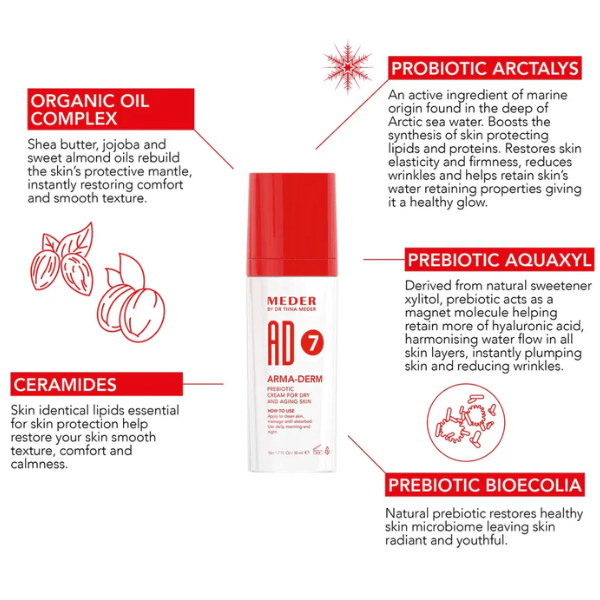
Sweet Almond Oil replenishes emollient lipids and immediately improves comfort and softness.
Ceramide-3 supports the skin's lipid barrier and helps reduce excessive moisture loss.
Aquaxyl™ supports the skin's ability to retain water and maintain healthy hydration.
Arctalys™ supports skin proteins and lipids involved in barrier quality, hydration and resilience.
Bioecolia® supports the microbiome.
And Vitamin E provides antioxidant protection while complementing the nourishing lipid phase of the cream.
So instead of:
dry skin → put oil on top
we have:
increase hydration → replenish lipids → support water retention → support microbiome → reinforce barrier → improve comfort.
That's why MEDER calls it 3D hydration.
WHAT DOES “3D HYDRATION” ACTUALLY MEAN?
It sounds like marketing language, so let's translate it.
MEDER uses "3D hydration" to describe the fact that Arma-Derm isn't relying on one moisturising mechanism.
It's working with:
the skin's water-holding structures
the lipid barrier
and the microbiome.
For me, the useful way to understand it is:
We're not just adding moisture.
We're trying to create skin that is better equipped to maintain its own moisture balance.
That is the difference between:
"My cream feels nice for two hours."
and
"My skin actually feels more comfortable as I continue using it."
That's what we're looking for.
WHY DOES MATURE SKIN OFTEN BECOME DRIER?
This is one of the reasons Arma-Derm fits so naturally into mature skincare.
As we age, several things change.
Sebum production can decline.
The composition of skin lipids changes.
Barrier recovery can become slower.
Natural moisturising mechanisms become less efficient.
And around menopause, declining oestrogen can further influence hydration, lipid production, collagen and barrier quality.
So somebody who had combination skin at 30 may suddenly find herself saying at 50:
"Nothing I used before is moisturising enough anymore."
That isn't necessarily because her old moisturiser suddenly became a bad product.
Her skin changed.
And skincare sometimes needs to change with it.
This is why Arma-Derm pairs so naturally with products such as Arma-Lift in mature and menopausal routines.
Arma-Lift addresses the age-related structural side.
Arma-Derm takes care of the dryness, hydration and barrier side.
DOES DRY SKIN AGE FASTER?
We need to be careful with this statement.
Having naturally dry skin doesn't mean you're automatically going to age dramatically faster than everybody with oily skin.
But dehydration and dryness can make signs of ageing look more obvious.
Fine lines appear deeper.
Texture looks rougher.
Skin reflects light less evenly.
The complexion can appear duller.
And chronically impaired barrier function makes the skin less resilient to environmental stress.
So restoring hydration can make skin look significantly younger without us having "removed" a structural wrinkle.
Sometimes we're simply allowing the skin to look like itself again — properly hydrated.
HOW TO USE ARMA-DERM
Arma-Derm is your face cream, so it comes towards the end of your MEDER routine.
A classic dry-skin routine may look like:
Net-Apax → Soin-Apax → Hydra-Fill → Arma-Derm
STEP 1 — CLEANSE
For dry and sensitive skin, I particularly like Net-Apax.
We want effective cleansing without leaving already-dry skin feeling stripped.
STEP 2 — APPLY YOUR EVERYDAY SERUM
Apply Soin-Apax or Energy-Soin according to your skin.
STEP 3 — APPLY YOUR TARGETED ACTIVE CARE
For significant dehydration, Hydra-Fill is the obvious pairing.
For mature skin, we may instead use Arma-Lift.
For longevity support, perhaps Vita-Long 2.0.
Your active step depends on the problem we're actually treating.
STEP 4 — APPLY ARMA-DERM
Apply approximately one pump over the face and neck.
Smooth it gently into the skin.
You don't need a thick visible layer.
A richer cream doesn't need to be applied excessively to work properly.
STEP 5 — SPF
During the day, finish with appropriate sun protection.
HOW OFTEN SHOULD I USE IT?
Arma-Derm is designed for daily use, morning and evening.
Unlike one of the targeted Active Care products, this isn't necessarily a 5–10 week treatment course.
It's a moisturiser.
If your skin is naturally dry and Arma-Derm is what keeps it comfortable, you can continue using it as part of your everyday routine.
You may also adjust it seasonally.
For example:
summer → Derma-Fill may be enough
winter → Arma-Derm may become necessary
or:
Derma-Fill during the day → Arma-Derm at night.
Your skincare doesn't have to remain identical 365 days a year.
YOUR MORNING ROUTINE
1. Net-Apax / Energy-Net
2. Soin-Apax / Energy-Soin
3. Targeted Active Care if prescribed
4. Arma-Derm
5. SPF
If you're using makeup, allow your skincare and sunscreen to settle before applying foundation.
YOUR EVENING ROUTINE
If you're wearing substantial makeup:
1. Remove your makeup
2. Net-Apax / Energy-Net
3. Soin-Apax / Energy-Soin
4. Targeted Active Care
5. Arma-Derm
Or, depending on your programme, you may use Arma-Derm during the day and Circa-Night in the evening.
The routine doesn't need to be complicated.
Dry skin usually benefits more from consistency and barrier respect than from endless layers of strong actives.
WHAT'S INSIDE IT?
Arma-Derm's formula is built around hydration, lipids, microbiome support and antioxidant protection.
SWEET ALMOND OIL
Sweet Almond Oil is rich in skin-compatible fatty components that help soften and nourish dry skin.
Its role is primarily emollient.
That means it helps fill the tiny spaces between dry surface cells, improving smoothness, flexibility and comfort.
This gives you that immediate:
"Ah — my face doesn't feel tight anymore."
But Sweet Almond Oil isn't there simply to make the cream feel luxurious.
It's helping restore the lipid-rich protective mantle that dry skin struggles to maintain.
DOES PUTTING OIL ON SKIN HYDRATE IT?
Not exactly.
This is an important distinction.
Water hydrates.
Oil helps soften and reduce water loss.
An oil can make dry skin feel dramatically more comfortable because it improves the lipid layer and helps reduce evaporation.
But if skin is severely dehydrated, oil alone doesn't magically replace the missing water.
That's why I like Arma-Derm's formulation.
It doesn't force us to choose:
water OR oil.
It addresses both.
We support hydration and the lipid structures helping keep that hydration inside the skin.
CERAMIDE-3
Ceramides are naturally occurring lipids found within the skin barrier.
And they're incredibly important.
Remember our brick-wall analogy?
Skin cells are the bricks.
Ceramides form part of the mortar holding that protective wall together.
When ceramide levels or organisation become compromised, the barrier becomes less efficient.
Water escapes.
Skin becomes more vulnerable.
Texture becomes rougher.
Sensitivity can increase.
Ceramide-3 in Arma-Derm helps support that lipid architecture.
So this isn't just an ingredient designed to make skin feel moisturised.
It's helping provide material that resembles something healthy skin already uses naturally.
AQUAXYL™
Aquaxyl™ is derived from plant sugars, including xylitol-related molecules.
Its job is centred around water balance.
It helps support the skin's natural mechanisms for holding and circulating water within its upper layers.
This is important because hydration isn't simply:
apply water → finished.
Healthy skin has sophisticated systems controlling where water moves and how effectively it is retained.
Aquaxyl™ supports that process.
Think:
help the skin become better at managing its own water.
ARCTALYS™
Arctalys™ is a marine-derived probiotic/postbiotic-type active sourced from microorganisms associated with Arctic marine environments.
MEDER uses it to support the synthesis of skin-protective proteins and lipids and to improve hydration, elasticity and resilience.
For me, the important part isn't that it comes from somewhere exotic.
It's what we're asking it to do:
support the biological structures that help dry skin behave more like healthy, resilient skin.
It works particularly nicely alongside Aquaxyl™ because one side of the formula supports hydration while the other helps reinforce the skin structures responsible for maintaining it.
BIOECOLIA® PREBIOTIC
Bioecolia® is a prebiotic.
We've met this ingredient elsewhere in the MEDER range.
Its job is to help support the beneficial microorganisms living on the skin.
Why does that matter in dry skin?
Because barrier function and microbiome health are closely interconnected.
When the barrier is disrupted, the microbial environment can change.
And when the microbiome becomes imbalanced, skin may become more reactive and less resilient.
So Arma-Derm doesn't treat dry skin as simply:
not enough cream.
It considers the skin's ecosystem too.
VITAMIN E
Vitamin E is a lipid-soluble antioxidant.
It helps protect skin lipids against oxidative stress while also supporting the nourishing character of the formula.
This becomes particularly useful in dry and mature skin because we're not only concerned with immediate comfort.
We also want to protect the skin against accumulated environmental stress.
Think of Vitamin E as helping defend the lipid side of the barrier while the rest of the formula restores it.
WHY DOES THE MICROBIOME MATTER FOR DRY SKIN?
Healthy skin isn't sterile.
Its surface is home to a complex community of microorganisms.
Those microorganisms interact with:
the barrier.
immune signalling.
inflammation.
and skin defence.
Dry, compromised skin can create a different environment on the surface, which may encourage imbalance.
And repeated use of aggressive cleansers and antimicrobial products can make the situation worse.
So when I treat dry skin, I don't want to simply cover it with oil.
I want to support:
water
lipids
barrier
microbiome.
That's the bigger picture.
IS ARMA-DERM A HEAVY CREAM?
It's nourishing, but MEDER has formulated it to absorb rather than simply sit as a greasy layer on top of the skin.
That distinction matters.
Dry skin needs lipids.
But nobody wants to feel as though they've covered their face in butter.
Use approximately one pump and give it a moment to settle.
If you apply three or four pumps because your skin feels dry, you're not necessarily getting three or four times the benefit.
If one pump consistently isn't enough, I would rather investigate why your skin is so dehydrated and adjust the routine underneath it.
More product isn't always the answer.
CAN OILY SKIN USE ARMA-DERM?
Technically, almost any skin can tolerate many different textures.
But that doesn't mean Arma-Derm is the most logical choice for oily skin.
MEDER specifically recommends Equa-Derm when excess sebum is the dominant concern.
Arma-Derm's richer lipid support can simply be more than oily skin needs.
If oily skin feels dehydrated, I would usually look first at Derma-Fill or Hydra-Fill rather than automatically reaching for Arma-Derm.
Remember:
dehydrated does not automatically mean dry.
That's why skin diagnosis matters.
CAN SENSITIVE SKIN USE ARMA-DERM?
Yes — particularly when sensitivity is connected with dryness and barrier weakness.
MEDER positions Arma-Derm as suitable for dry, dehydrated and flaky skin and specifically notes its calming and barrier-supportive benefits.
But not every sensitive skin is dry.
If your skin is sensitive but neither oily nor dry, Salva-Derm may be the more logical everyday moisturiser.
So:
sensitive + dry → Arma-Derm may be ideal
sensitive + normal → Salva-Derm may make more sense
Again, we're treating the actual skin rather than simply the word "sensitive."
CAN I USE DERMA-FILL UNDER ARMA-DERM?
Absolutely.
And this is one of my favourite combinations for dry + dehydrated skin.
The order is:
Derma-Fill → Arma-Derm
Derma-Fill gives us the lightweight water-focused hydration layer.
Arma-Derm follows with richer lipid and barrier support.
Think:
Derma-Fill = put water into the system
Arma-Derm = help the skin retain and protect that moisture.
This can be particularly useful during:
winter.
travel.
periods of extreme dryness.
menopause.
air-conditioned environments.
or whenever dry skin suddenly needs more support than usual.
You don't necessarily need this double layer forever.
Use it when the skin needs it.
ARMA-DERM AND HYDRA-FILL — WHAT'S THE DIFFERENCE?
The names can make these sound as though they do the same thing.
They don't.
HYDRA-FILL
Hydra-Fill is a targeted Active Care serum.
Its primary focus is intensive hydration and improving the skin's ability to retain water.
It goes before your cream.
ARMA-DERM
Arma-Derm is your moisturising cream.
It provides hydration but also gives us substantial lipid, barrier and protective support.
It goes after your Active Care.
So for very dry, dehydrated skin:
Hydra-Fill + Arma-Derm
isn't necessarily duplication.
One gives us targeted hydration.
The other completes the routine by supporting the lipid barrier and helping protect that hydration.
ARMA-DERM AND ARMA-LIFT — WHAT'S THE DIFFERENCE?
These two are often paired in mature skincare, but they have completely different jobs.
ARMA-LIFT
A targeted age-well Active Serum.
Think:
collagen.
elasticity.
mature skin changes.
menopausal skin.
structural ageing.
ARMA-DERM
A moisturising cream.
Think:
dryness.
lipids.
water retention.
barrier comfort.
So a mature-skin routine may look like:
Energy-Net → Energy-Soin → Arma-Lift → Arma-Derm
Arma-Lift addresses how the skin is ageing.
Arma-Derm addresses how the skin is staying hydrated and protected while it ages.
ARMA-DERM OR DERMA-FILL?
This is probably the most useful comparison.
CHOOSE DERMA-FILL IF...
Your skin mainly needs:
water
lightweight hydration
surface plumping
or something comfortable underneath SPF and makeup.
It's particularly useful for normal, oily and combination skin.
Think:
HYDRATE.
CHOOSE ARMA-DERM IF...
Your skin is:
dry
flaky
lipid-deficient
tight
or mature and increasingly lacking comfort.
Think:
HYDRATE + NOURISH + PROTECT.
And if your skin is both dry and dehydrated?
Use:
Derma-Fill → Arma-Derm
when necessary.
ARMA-DERM OR SALVA-DERM?
These are also easily confused because both can be used when skin is uncomfortable.
ARMA-DERM
Choose it when dryness and lipid deficiency are dominant.
SALVA-DERM
Choose it when sensitivity and reactivity are dominant, without significant oiliness or dryness.
So don't choose based only on:
"My face feels uncomfortable."
Ask:
Why does it feel uncomfortable?
Dry?
Reactive?
Dehydrated?
Inflamed?
Different causes need different solutions.
ARMA-DERM OR CIRCA-NIGHT?
You don't necessarily have to choose.
Arma-Derm is primarily your dry-skin moisturiser.
Circa-Night is MEDER's specialised night cream, designed around overnight recovery and circadian skin biology.
MEDER specifically says the two can be combined by using:
Arma-Derm in the morning
and
Circa-Night before bed.
That can be a lovely routine when dry or mature skin needs daytime protection but you also want dedicated overnight care.
IS ARMA-DERM GOOD IN WINTER?
Yes — this is exactly when many clients suddenly discover they need it.
Winter gives the skin a difficult combination:
cold outdoor air.
wind.
low humidity.
central heating.
hot showers.
constant movement between warm and cold environments.
All of this can increase moisture loss.
Someone who comfortably uses Derma-Fill during summer may suddenly need Arma-Derm once temperatures drop.
That's normal.
Your skin isn't being inconsistent.
Its environment changed.
Good skincare should be flexible enough to change with it.
WHAT ABOUT SUMMER?
Dry skin doesn't stop being dry because it's July.
If Arma-Derm remains comfortable, continue using it.
But if it begins feeling too rich underneath SPF, we can adjust.
Perhaps:
Derma-Fill in the morning
and
Arma-Derm at night.
Or use a smaller amount.
Or reserve Arma-Derm for particularly dry areas.
The product should serve your skin.
Your skin doesn't need to obey the product.
IS ARMA-DERM GOOD UNDER MAKEUP?
Yes, provided you use the right amount and allow it to absorb.
Dry skin often causes foundation to:
catch on flakes.
settle into lines.
look patchy.
and become increasingly obvious as the day goes on.
Restoring proper moisture and barrier comfort gives makeup a much better surface.
If Arma-Derm feels too rich underneath your particular foundation, use Derma-Fill during the day and keep Arma-Derm for evening.
There's no prize for forcing one moisturiser to perform every job.
WHAT IF MY SKIN IS STILL FLAKY?
If you've used Arma-Derm consistently and the skin remains persistently flaky, I don't simply want you applying thicker and thicker layers.
We need to ask why.
Are you over-cleansing?
Using too many exfoliating acids?
Using retinoids too aggressively?
Taking very hot showers?
Living in an extremely dry environment?
Is there dermatitis or another skin condition?
Is your skin reacting to another product?
A good moisturiser can support the barrier.
But it can't compensate indefinitely for something in the routine continuously damaging that barrier.
Sometimes the best thing we can add to skincare is actually:
less.
CAN ARMA-DERM HELP FINE LINES?
Yes — particularly when dryness and dehydration are exaggerating them.
When skin becomes properly hydrated and the barrier is better supported, it appears:
plumper.
smoother.
more flexible.
and less creased.
That can make fine lines look noticeably softer.
But Arma-Derm isn't an injectable filler and it isn't designed to physically erase deep structural wrinkles.
If established age-related changes are the main concern, we may pair it with Arma-Lift or Vita-Long 2.0.
Arma-Derm creates the healthy moisturised environment.
Your Active Care provides the more targeted correction.
WHEN WILL I SEE A DIFFERENCE?
Comfort should be one of the first things you notice.
Dry skin should begin feeling:
softer
less tight
more flexible
more comfortable
and better nourished.
The surface should gradually appear:
smoother
plumper
less flaky
and more luminous.
Barrier improvement takes consistency.
So although Arma-Derm can make the skin feel better immediately, I don't want you judging the entire result from one application.
Give the skin time to recover from the dryness cycle.
Especially if you've been over-exfoliating or chronically stripping the barrier.
MY ARMA-DERM RULES
If you remember nothing else from this page, remember these:
Dry and dehydrated are not the same thing.
Dry skin lacks lipids. Dehydrated skin lacks water. You can have one or both.
Oil isn't the same as hydration.
Lipids help soften and reduce moisture loss; water provides hydration. Healthy dry skin usually needs both.
Barrier health matters.
If your skin can't retain moisture properly, constantly adding more moisturiser only solves half the problem.
Ceramides aren't just trendy ingredients.
They're naturally part of the skin's protective lipid structure.
Don't over-cleanse dry skin.
Your moisturiser shouldn't spend all day repairing damage your cleanser creates every morning.
Arma-Derm isn't automatically for everyone with tight skin.
Oily, dehydrated skin may need Derma-Fill or Hydra-Fill instead.
Layer intelligently.
For very dry + dehydrated skin, Derma-Fill can go underneath Arma-Derm.
Adjust with the seasons.
The moisturiser you need in January doesn't necessarily have to be the moisturiser you need in July.
Give your barrier time.
Comfort can improve quickly, but genuinely healthier barrier function comes from consistent care.
THE BOTTOM LINE
Arma-Derm is the cream I want you to think of when hydration alone isn't solving the problem.
When your skin feels:
dry.
tight.
flaky.
fragile.
constantly thirsty.
or increasingly uncomfortable as it matures.
We need to look beyond simply putting more water onto the surface.
We're supporting the water inside the skin.
The lipids that help keep it there.
The ceramides forming part of the barrier.
The microbiome living on the surface.
And the antioxidant systems helping protect that entire environment.
That's why Arma-Derm makes sense for genuinely dry skin.
It's not about making your face feel coated.
It's about helping dry skin become comfortable, flexible, resilient and better able to protect itself again.
Because the goal of a good moisturiser isn't for you to spend the entire day thinking about how dry your face feels.
The goal is eventually to stop thinking about it at all.
ARMA-DERM AT A GLANCE
What is it?
A nourishing face cream designed to restore hydration, lipids and barrier comfort in dry, dehydrated and flaky skin.
Best for:
Dryness, dehydration, flaking, tightness, fine dehydration lines, mature skin, sun-damaged skin and weakened barrier function.
Recommended age:
25+
Skin type:
Primarily dry and very dry skin. Particularly useful when dryness and dehydration occur together.
How often?
Morning and evening.
How much?
Approximately one pump for the face and neck is usually sufficient.
Is it only for mature skin?
No. MEDER recommends it from approximately 25+ when dryness or flaking is present. Mature skin simply tends to benefit particularly well because dryness often increases with age.
Can sensitive skin use it?
Yes, particularly when sensitivity is associated with dryness and impaired barrier function.
Is it suitable for oily skin?
Usually not the first choice. MEDER recommends Equa-Derm for genuinely oily skin; dehydrated oily skin may benefit more from Derma-Fill.
Can I layer Derma-Fill underneath it?
Yes. This is an excellent combination when skin is both dry and dehydrated.
Can I use Hydra-Fill with it?
Yes. Hydra-Fill is your targeted hydration serum; Arma-Derm follows as your nourishing barrier-supportive cream.
Can I use Arma-Lift with it?
Yes. Arma-Lift + Arma-Derm is a particularly logical combination for dry, mature or menopausal skin.
Can I use Circa-Night as well?
Yes. One option is Arma-Derm in the morning and Circa-Night at night.
Hero ingredients:
Sweet Almond Oil, Vitamin E, Arctalys™, Aquaxyl™, Bioecolia® and Ceramide-3.
What comes before it?
Cleanser → everyday antioxidant serum → targeted Active Care if you're using one.
What comes after it?
SPF during the day.
Size:
50 ml